

For years, Europe has chased interoperability. Every country has tried, in its own way, to build portals, shared care records, registries, and national platforms. Some succeeded. Others struggled. All worked in parallel, often fragmented and rarely aligned. The European Health Data Space (EHDS) changes this. For the first time, Europe is saying: “Let’s build this together. Let’s speak the same data language.”
This ambitious goal highlights the need for national EHDS infrastructure capable of connecting diverse health systems into a coherent data backbone.
EHDS regulation and what it requires from health systems
EHDS is no longer a policy debate, it is law. The European Health Data Space (EHDS) will require countries to build national infrastructures capable of connecting diverse healthcare systems. These platforms aggregate data from multiple EHR systems, harmonise semantics, enforce governance rules, and enable secure cross-border exchange through MyHealth@EU.
Regulation (EU) 2025/327 entered into force on 26 March 2025, creating the first EU-wide legal, technical, and governance framework for sharing and reusing electronic health data. The timelines are firm: by March 2029, every member state must support cross-border exchange of patient summaries, e-prescriptions, and e-dispensations, and all commercial EHRs must be certified, and by 2031, medical imaging, lab results, and discharge reports will join the mandatory data set. Non-compliance comes at a cost: financial penalties of up to €20 million or 4% of global turnover, and non-EHDS-compliant systems cannot be marketed in the EU.
Yet beneath the regulatory pressure lies a far larger opportunity that stakeholders increasingly recognise, a chance to finally modernise Europe’s fragmented digital foundations.
EHDS is about shifting value from siloed clinical applications to shared data, semantics, and governance. It marks the moment when interoperability becomes a public good, and when platforms built on open standards can help Europe leap forward where traditional EHR architectures fall short.
What stakeholders expect EHDS to unlock?
Across Europe, stakeholder conversations about EHDS carry a familiar mix of excitement and unease. “It’s huge,” “It’s unclear,” “It’s overdue,” “It’s our chance to finally fix this.” Yet despite concerns about timelines, governance, and the unfinished state of the implementing acts, a shared belief keeps resurfacing: EHDS could finally deliver what health systems have been missing for years. Stakeholders envision:
- Real continuity of care, where a patient’s history follows them across providers and borders.
- Standardised citizen access through national portals and the future European Digital Identity Wallet integrated with MyHealth@EU.
- High-quality structured data that can power planning, analytics, AI, and research.
- A vendor-neutral, future-proof ecosystem capable of evolving as clinical practice evolves.
Want a deeper analysis of EHDS readiness across Europe?
There is hope that Europe can finally establish a coherent and interoperable health data ecosystem, one that is vendor-neutral, future-proof, and capable of evolving as clinical practice evolves. But hope alone doesn’t make systems interoperable — architecture does.
Why vendor compliance alone will not deliver EHDS
Although the EHDS regulation mandates two harmonised software components inside every EHR, a European Interoperability component and a European logging component, the assumption that vendor compliance alone will deliver interoperability simply does not hold.
Europe’s healthcare landscape is fragmented across hundreds of EHR vendors with wildly varying architectures, from legacy systems with minimal FHIR support to newer systems that promote “FHIR readiness” more in slides than in production. Many lack semantic governance, IPS generation, or robust audit capabilities; smaller vendors lack certification capacity; larger ones focus on national priorities rather than EU alignment. No country can realistically enforce consistent semantics, consent logic, and audit behaviour across dozens of EHR products.
The reality is clear: a purely vendor-to-EU model will fail. A national interoperability layer, standardised, governed, and centrally orchestrated, is essential for EHDS to function at all.
The national infrastructure needed for EHDS interoperability
Across Europe, a consistent architectural pattern is emerging: national EHDS infrastructure layers that sit between clinical systems and the European MyHealth@EU infrastructure. This national layer absorbs the complexity that EHR vendors cannot realistically handle on their own — ensuring semantic alignment, data quality, consent enforcement, IPS generation, and full auditability before anything crosses a border. This national layer includes four interconnected components:
- A shared care record providing the clinically coherent, normalised data foundation, often built on structured clinical models such as openEHR.
- A vendor integration layer that federates and harmonises outputs from diverse EHR systems.
- A national EHDS gateway exposing a unified FHIR façade, applying semantic and consent rules.
- A transitional bridge linking existing National Contact Point for eHealth (NCPeH) infrastructure with the future EHDS framework.
Together, these layers create a governed, scalable national backbone that shields clinicians and vendors from complexity while delivering the reliability Europe needs.
No-regret investments: what every country should build now
Our research across European markets consistently surfaces one strategic insight: the most valuable investments are those that deliver benefits regardless of how EHDS timelines unfold. Given uncertainty around governance structures, funding continuity, and implementing acts still taking shape, “no-regret” investments provide a reliable anchor. These capabilities strengthen digital health systems broadly while simultaneously reducing EHDS risk:
- Data quality and semantic infrastructure — structured capture, controlled terminologies, shared clinical models.
- Identity, consent, and auditability — the trust mechanisms that make cross-organisational exchange possible.
- Modular architectures that decouple data persistence from exchange and can evolve as requirements mature.
- Organisational capability — internal expertise, clinical engagement, and change management that no vendor can substitute.
Better Platform is designed around these exact principles. Countries that invest here today are not just preparing for EHDS, they are strengthening their entire digital health foundation.
Shared care records as the foundation of EHDS infrastructure
One of the clearest insights from research across European markets is that many countries already possess the very infrastructure EHDS now requires. Shared care records have been solving EHDS’ foundational challenges for years: aggregating data from heterogeneous EHRs, harmonising semantics, offering clinician views and patient portals, and integrating dozens of systems into a coherent whole.
For smaller or centralised countries like Slovenia, Malta, Ireland, Cyprus, Greece, or Portugal, a national shared-care record naturally becomes the spine of the EHDS architecture, thus EHDS is not a reinvention but an evolution. For larger, federated markets such as Germany, Spain, the Netherlands, Sweden, France, or Italy, regional shared-care records or health information exchanges can play the same role, harmonising data locally before passing it to the national gateway.
The shared-care record simply grows into its new responsibilities:
- Becoming the persistent patient data layer feeding the EHDS gateway.
- Extending semantic normalisation pipelines to ensure data is clean and coded before crossing borders.
- Widening FHIR APIs from clinician access to citizen and cross-border use.
- Expanding IHE-based document exchange into the federated MHDS gateway model.
Because these systems were built with modularity in mind, new components such as consent orchestration and terminology governance can be added with minimal disruption. EHDS, in this context, is not a disruptive rebuild, it is the natural widening of an architecture already designed to connect, adapt, and interoperate.
Platforms behind EHDS infrastructure
EHDS will not be delivered by legacy EHR stacks or theoretical blueprints. The policy shifts the centre of gravity from the EHR to the interoperability backbone. Traditional EHR vendors built systems for a different era, with clinician workflow, billing logic, and proprietary models designed to own the clinical interface, not serve as a neutral national infrastructure. EHDS infrastructure will be built by platforms that already do the hard work: structuring data, governing semantics, orchestrating consent, and exchanging information reliably across regions and systems.
As Member States step into the EHDS era, Better offers not just compliance, but a competitive advantage: a complete, extensible, production-tested foundation ready to power the health data space Europe has been waiting for. Better Platform doesn’t compete with EHRs; it connects them, enabling national infrastructures they cannot build alone.
A modern EHDS-ready platform requires a coherent architecture where data, semantics, exchange, and access control work as one. Better Platform delivers precisely this:
- Data foundation
A vendor-neutral clinical data layer built on openEHR — ensuring structured, future-proof data that reliably transforms into IPS datasets. This is the semantic backbone that makes everything else possible.
- Semantic layer
FHIR Terminology Services, governed value sets, and mapping pipelines to SNOMED CT, LOINC, and EU standards. Terminology governance is Europe’s biggest bottleneck, and Better addresses it natively.
- Hybrid exchange
FHIR APIs for real-time access combined with IHE XDS/MHD/MHDS for federated document workflows — covering both modern and legacy exchange patterns without compromise.
- Consent and access control
A flexible consent engine enforcing national policies, opt-in/opt-out models, and granular restrictions, supported by attribute-based access control already in production at national scale.
- Application development
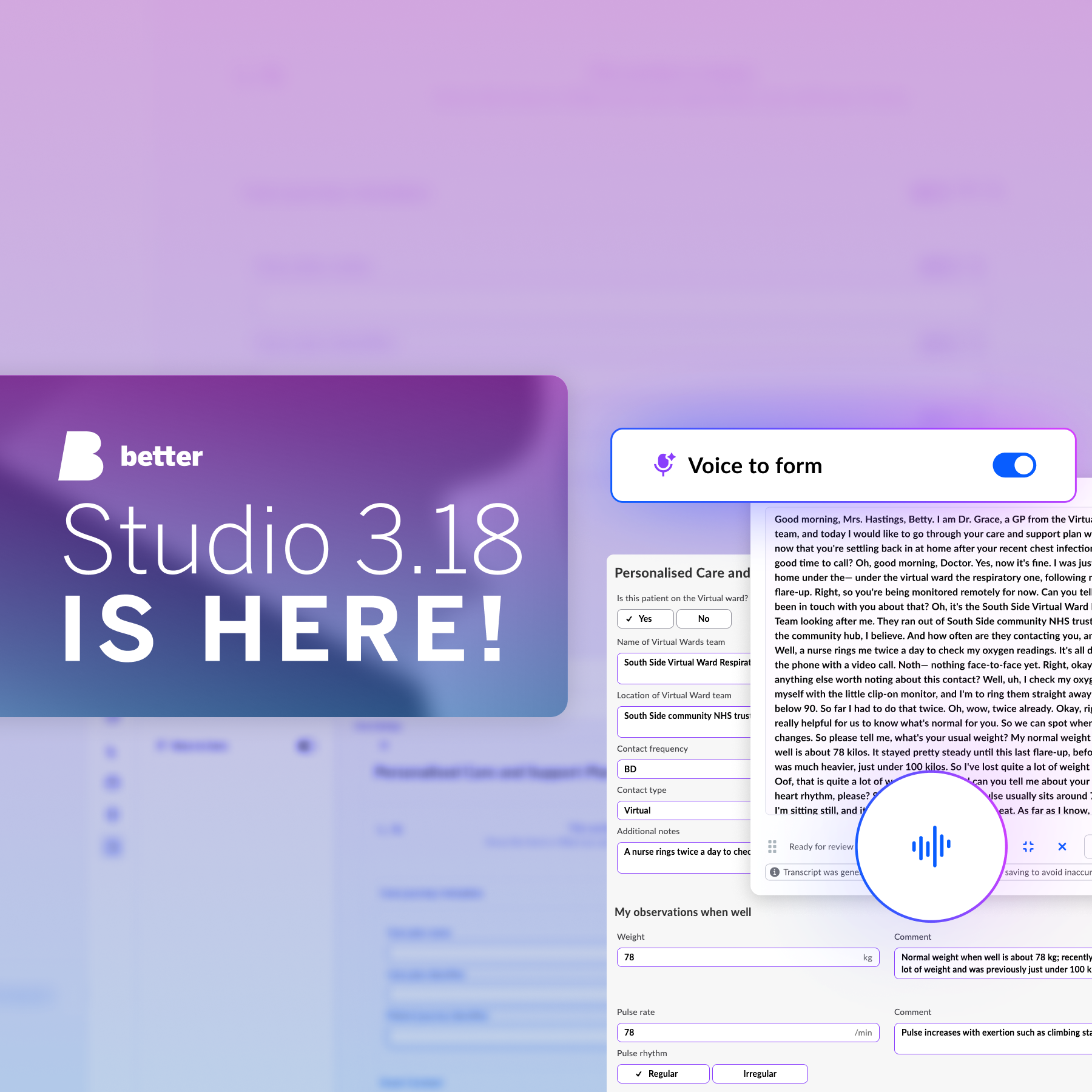
Better Studio — a low-code development environment enabling rapid creation of clinical applications that integrate seamlessly into existing workflows via SMART-on-FHIR and SMART-on-openEHR launches.
The combination of the above-mentioned features is what turns EHDS from a regulatory burden into an architectural capability. It is not a future roadmap, but a proven infrastructure operating at a national scale today in many countries like Slovenia, Malta, Ireland, and others.
The opportunity behind the obligation
EHDS will reshape national strategies, vendor landscapes, and the expectations of clinicians and citizens across the continent. The real story here isn’t compliance, it’s modernisation. Europe is finally building health data infrastructures that are interoperable, patient-centric, and future-proof.
EHDS will not be implemented system by system. It will emerge through national infrastructures that connect existing clinical systems into a shared data backbone. In many countries, shared care records built on modern interoperable platforms are becoming the foundation of EHDS infrastructure.
To understand how shared care records evolved into this role, explore their development and the architectural thinking behind them.