




Spirometry’s value grows when results live in the EHR as structured data, not PDFs or siloed device files. Respiratory care depends on trends over time, so lung function data must be searchable, comparable, and paired with clinical context. The real question isn’t whether spirometry is digital, but whether the data can be reused. Better Marketplace supports this with free openEHR-based respiratory assets: spirometry forms, trend visualisations, calculators, substance use summaries, and acute assessment tools to help organisations build reusable respiratory pathways faster.
Every day, healthcare organisations generate valuable respiratory data through spirometry testing, and too much of it still ends up as PDFs, scanned reports, or files trapped inside device software. PDFs do have a place. For a one-off occupational health test or a referral attachment, a document may be perfectly adequate. The trouble starts when the next result arrives six months later, then another year after that, and someone has to reconstruct the patient’s trajectory by opening old reports one by one.
That is when spirometry stops feeling digital and starts feeling archival. Lung function is understood through change over time. If respiratory measurements sit in the EHR as computable data rather than static documents, clinicians can review trends, use results in clinical decision support, and analyse patterns across services.
Respiratory care depends on trends, not snapshots
A single spirometry test is useful, but respiratory decisions are rarely made on a single value alone. Clinicians need to know whether lung function is stable, whether treatment is improving outcomes, and whether deterioration is beginning. In practice, that means comparing several results across months or years, not just looking at one report.
Many digital projects fail because they see documentation as the final step. In respiratory medicine, documentation is important, but it is only the starting point. Spirometry data is far more valuable when viewed alongside a patient’s full history, that is including past tests, predicted values, and smoking habits. If clinicians have to hunt through scanned letters during a busy clinic to find this context, that value can be lost.
Why respiratory data changes clinical work
1. Standardised interpretation and reference values
Lung function test results only make sense in context. Predicted values, lower limits of normal, patient demographics, and the relevant guidance all shape interpretation. When those elements are recorded as reusable data inside the record, clinicians are more likely to work from the same clinical frame across settings.
2. Embedded clinical decision support
Clinical decision support only works when systems can read the result. If the clinician has to open a report, scan the numbers, and do the comparison manually, spirometry remains retrospective. If the system can recognise an abnormal result or a decline over successive tests, the measurement becomes part of the live clinical workflow instead of an attachment reviewed later. That is a material difference in a clinic where one clinician may review dozens of results in a single session.
3. Advanced analytics and population health management
Respiratory disease creates a heavy burden for healthcare systems, and population-level review needs searchable data. PDFs do not lend themselves to that job. A service trying to understand outcomes across 2,000 patients with chronic respiratory disease cannot sensibly rely on manually reading documents from multiple systems. Reusable spirometry values make it possible to identify higher-risk groups, monitor progression, and assess treatment effectiveness with far less friction.
4. Preparing respiratory data for AI and research
AI and research both depend on usable source data, but scanned PDFs are poor raw material for models that need reliable respiratory measurements. The immediate priority isn’t just fulfilling an AI strategy on paper; it’s making sure the organization can use the data it already paid to collect. Both research and predictive analytics depend on that level of consistency.
Building connected respiratory care faster with Better Marketplace
There is a fair objection here. Most organisations do not want a large redesign project simply to improve how spirometry is captured. That is exactly why implementation assets matter.
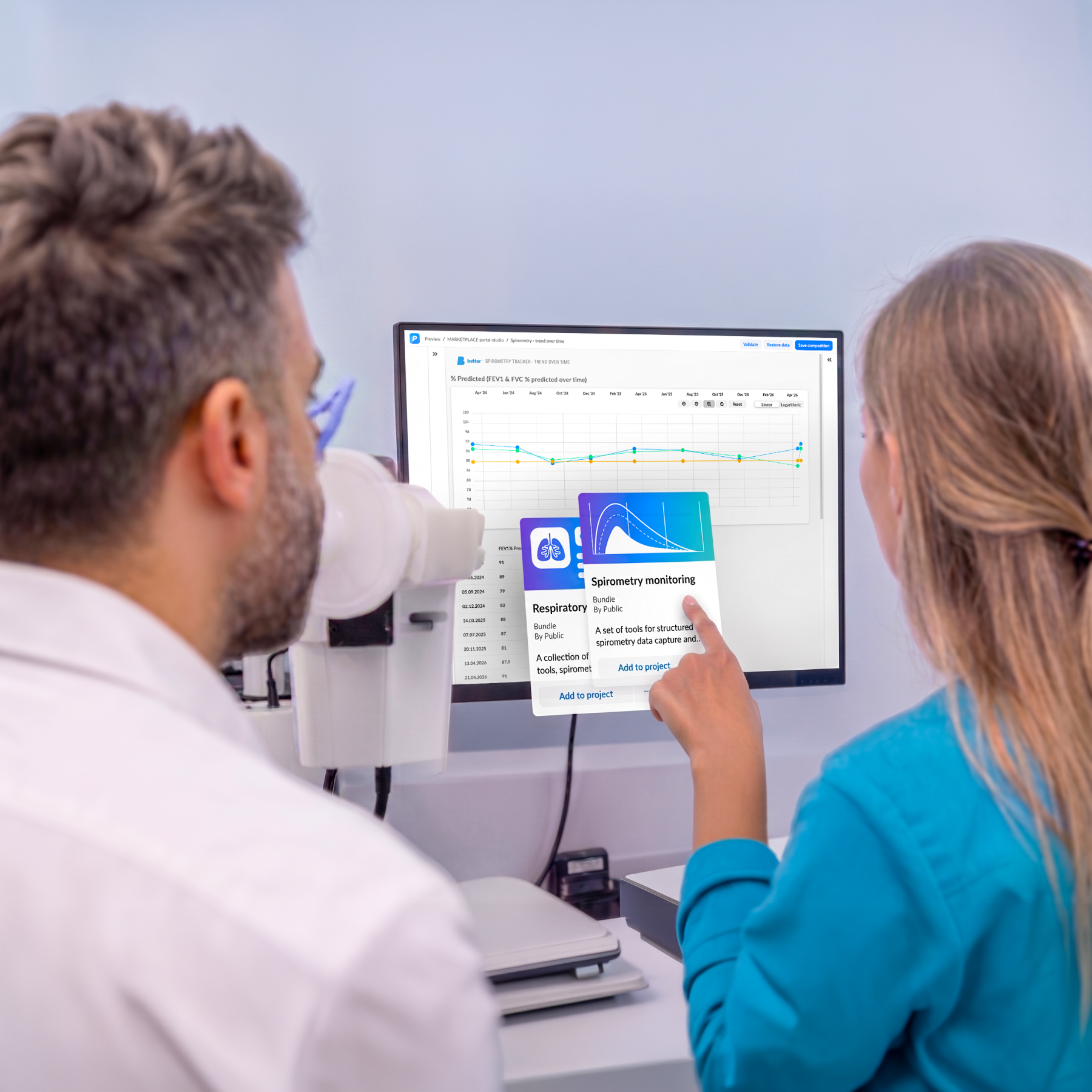
Better Marketplace provides a free set of respiratory forms, templates, assessments, and other clinical tools built on openEHR standards for interoperable healthcare environments. These resources are designed to speed up the implementation of digital respiratory pathways while ensuring respiratory data is captured as reusable clinical information. The Respiratory bundle includes spirometry entry forms, result templates, longitudinal tracking tools and visualisations, respiratory assessments, and clinical scoring systems that support care across different settings.
The bundle’s core assets are designed to work together within a single patient record. It includes:
- spirometry entry forms with and without predicted values;
- a spirometry result template and peak flow tracker that bring together clinic spirometry and home monitoring devices;
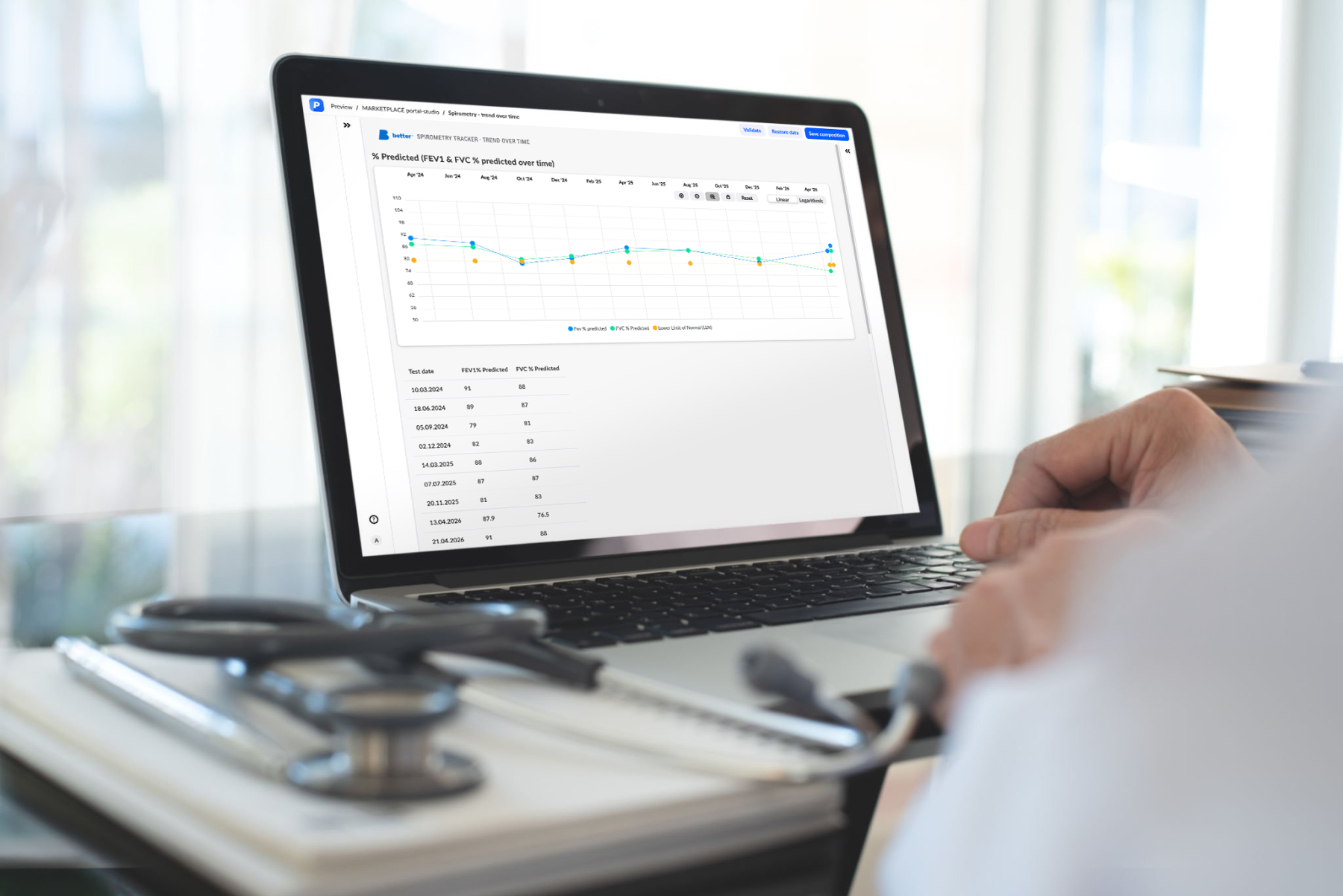
- a trend-over-time tracker for spirometry results;
- tobacco smoking, vaping, and substance use summaries and assessments;
- a spirometry result over time widget that turns historical lung function into a visual graph;
- supporting context tools, including BMI and BSA tools, provide inputs for lung function prediction;
- and for acute and risk assessment, the bundle also includes CRB-65, CURB-65, Murray score, PaO₂/FiO₂ ratio, and a pack years calculator.
We believe that the clinical teams need components that fit actual clinics: clean data entry, trend views, exposure history, and acute scoring in one record. Better Marketplace and Better Studio support that approach through free, reusable openEHR-based assets that help organisations build respiratory pathways more quickly while keeping data models consistent.
Conclusion
The harder question is governance, not digitisation. Once spirometry sits inside a document repository or a device application, the organisation may still struggle to reuse it across the record. Respiratory teams should not have to renegotiate access to their own clinical meaning every time a device, module, or supplier changes.
That is why openEHR matters here. The source material positions it as the basis for interoperable respiratory records that remain computable across systems and over time, and it is why vendor-neutral standards are more than a technical preference. They determine whether lung function data stays useful after the original report has been filed away. Better Marketplace supports that model through free, reusable assets built on openEHR.
Ready to modernise your respiratory pathways? Explore the free respiratory assets in Better Marketplace and see how reusable openEHR building blocks can support respiratory pathways, reduce implementation effort, and make better use of respiratory data.