



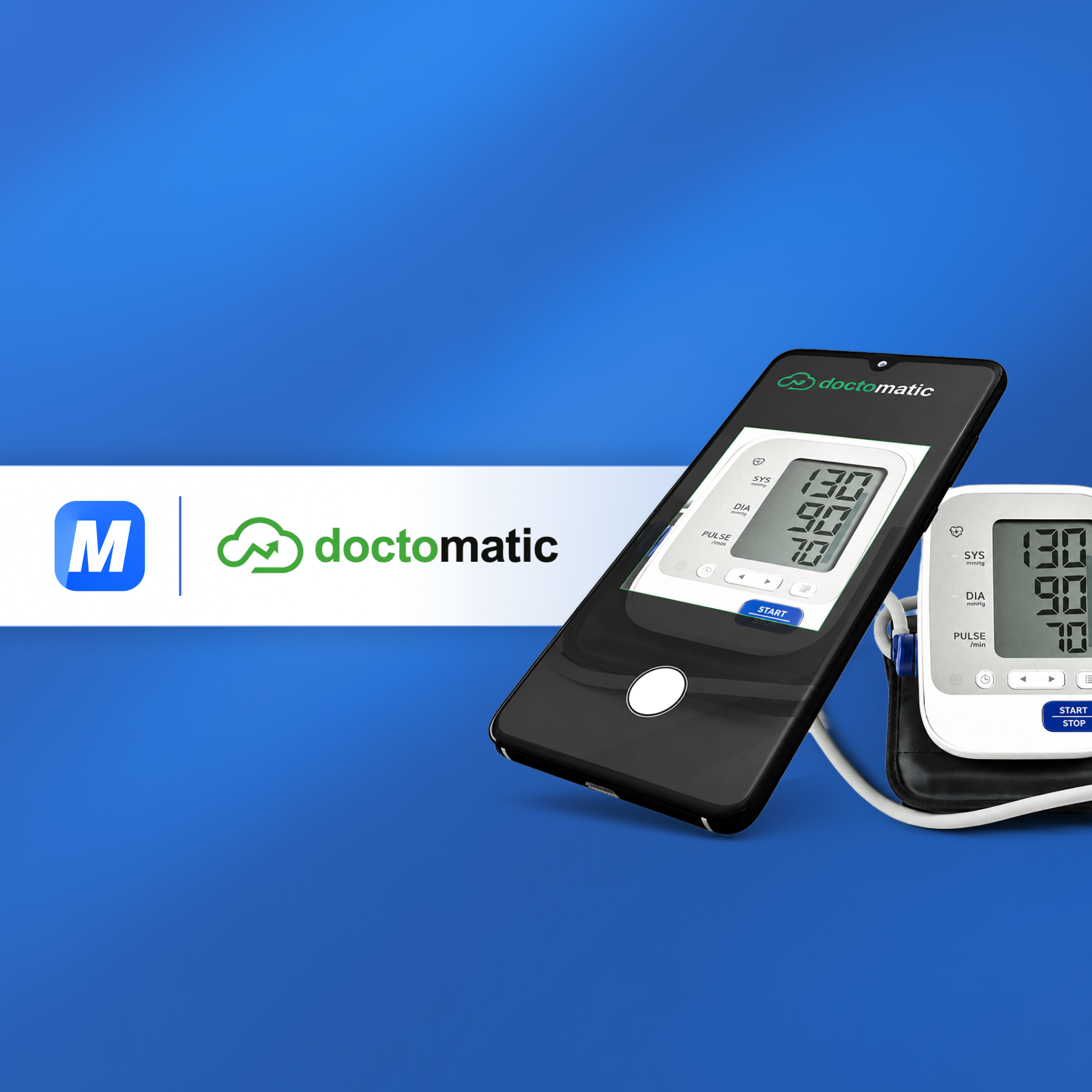
Medical devices generate valuable health data. The challenge is getting those readings off disconnected screens and into the digital systems used by care teams without relying on manual transcription, Bluetooth pairing, or a separate integration for every manufacturer.
Doctomatic approaches medical device data integration as an architectural problem. Instead of connecting every device individually, it creates a single data-ingestion layer: computer vision captures readings directly from supported device screens, while one API delivers them as structured data to the connected platform.
Why is medical device data integration still difficult?
Healthcare organisations use a wide range of medical devices across wards, homes, and remote care programmes. Blood pressure monitors, glucometers, pulse oximeters, thermometers, and scales among other digital medical devices may all generate clinically useful readings, but many devices were never designed to exchange data with other systems.
Getting those readings into a digital workflow usually means choosing between several imperfect options. Healthcare professionals can transcribe values manually, adding administrative work and the risk of errors. Patients can pair compatible devices through Bluetooth, but setup and connection problems can create friction, particularly for people who are less confident with technology. Alternatively, organisations can rely on manufacturer-specific cloud platforms, which may require separate integrations and tie data flows to individual device ecosystems.
The challenge becomes even greater at scale. Supporting more devices can mean building and maintaining more integrations, managing different connection methods, or asking patients and care settings to standardise on specific connected hardware.
The data already exists. The difficult part is creating a simple and scalable way to capture it.
How can one API connect data from different medical devices?
Doctomatic provides a single data-ingestion layer for supported medical devices.
Rather than communicating directly with each device, Doctomatic reads the information already visible on its screen. A smartphone camera captures the display, computer vision identifies the values, and the confirmed readings are converted into structured data.
For integration teams, the key difference is what happens next. Instead of building a separate connection for every supported device or manufacturer ecosystem, a digital health platform can integrate with Doctomatic once through a single API and receive structured readings from across the supported device range.
Because the capture method reads the device display rather than connecting directly to the hardware, Doctomatic can work across supported brands, models, and older non-connected devices.
Doctomatic is available both as an API that can be embedded into another platform and as a white-label application, giving organisations different options for introducing the capture workflow into their own digital services.
The solution was recently featured as a real-world implementation case in the WHO Regional Office for Europe report Bridging theory and practice: implementation insights on artificial intelligence in health care, which examines practical lessons from AI implementation in healthcare.
How does the photo-to-data workflow work?
For the person taking the measurement, the workflow is deliberately simple.
The patient or healthcare professional takes a photo of the device display. Doctomatic reads the values shown on screen and presents the captured reading for confirmation. Once confirmed, the values are saved as structured data and sent into the connected digital workflow.
Keeping the user in the confirmation loop means they can review the captured values before submission rather than relying on an invisible background transfer.
The same basic process can support readings across a range of everyday monitoring devices. Once readings reach the care team, they can be presented as trends over time. When a value falls outside thresholds set for the patient, the clinical team can also receive an automated alert.
The device itself does not need to be paired with a phone or connected to the internet. The screen provides the information, and the smartphone camera becomes the capture point.
Why does device-agnostic integration matter for connected care?
Medical device integration is often treated as a device-by-device problem. Every new model or manufacturer can introduce another connection to configure, support, and maintain.
A device-agnostic approach changes that model. By using the device screen as the capture point, Doctomatic separates data capture from the connectivity built into the hardware itself.
For healthcare organisations, this can make it easier to support a broader device landscape. Patients can continue using familiar devices, care programmes do not have to depend entirely on connected hardware, and digital platforms can receive structured readings through a common integration layer.
This is particularly relevant for remote monitoring, hospital-at-home, chronic care, and ward-based monitoring, where collecting reliable readings across different settings and devices is essential.
The value is not simply connecting more devices. It is reducing the number of separate pathways needed to make their data usable.
From disconnected readings to reusable health data
Medical device data should not stop at the screen where it was generated. To support connected care, readings need a path into the wider digital environment where they can contribute to monitoring, trends, workflows, and clinical follow-up.
Doctomatic helps create that path by turning readings from supported medical device screens into structured data through a single integration layer.
At Better, we believe healthcare data should remain accessible and reusable across systems and care settings. Doctomatic supports that vision by helping medical device readings move beyond isolated screens and into digital workflows where the data can be used over time.
As a device-agnostic data capture solution on Better Marketplace, Doctomatic adds another reusable capability to the open ecosystem enabled by Better.
Partner with Better
Access a growing healthcare ecosystem built on open standards and expert support.