

Clinicians often rely on risk scores to guide care, yet those calculators usually live on separate websites or mobile apps. This fragmentation disrupts workflows and keeps valuable data out of the patient record. Better Marketplace is building clinical libraries that bring validated cardiology calculators directly into the EHR, starting with familiar scores like CHA₂DS₂‑VASc and GRACE. By combining workflow integration with openEHR standards, the approach promises greater efficiency and long‑term interoperability.
Executive summary
- Integrated tools: traditional tools like CHA₂DS₂‑VASc, HAS‑BLED, ATRIA, GRACE, CRUSADE and HEART are widely used to assess stroke, bleeding and mortality risk in cardiology. Their utility is well validated, but they often sit outside the electronic health record (EHR).
- Workflow gains: moving these calculators into the EHR eliminates context‑switching, reduces manual data entry and ensures results are stored with the patient’s record. Clinicians save time and reduce errors.
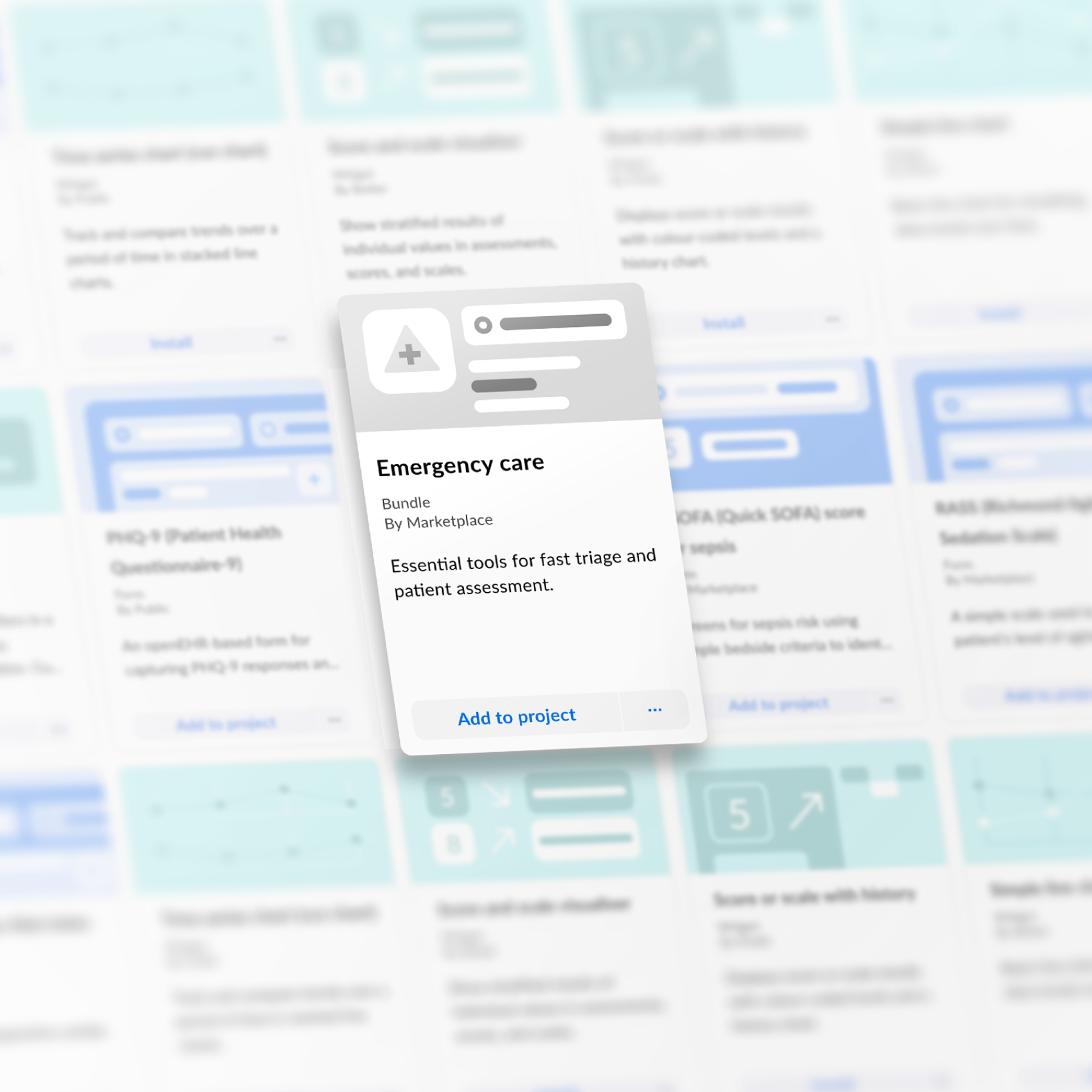
- Better Marketplace: the first clinical bundle focuses on cardiology, bundling proven risk scores and general indices (BMI, BSA, NYHA and RCRI) in an interoperable package. Built using openEHR archetypes, these tools draw data from the record and write results back.
- Open standards: openEHR separates clinical models from application logic, allowing long‑term data storage, version control and interoperability across systems.
Using archetypes means tools can be adapted to local guidelines without locking data into proprietary formats.
Moving beyond external apps
You are in ED. You need a GRACE score. The WiFi’s lagging, your phone’s dead, and the app is asking to update. Now what? Every clinician knows the routine: risk scores live on websites, in mobile apps, or on paper charts. They are trusted tools like CHA₂DS₂-VASc, HAS-BLED, GRACE, but they sit on the sidelines, away from the patient record. The result? Extra steps, missing data, and knowledge that never quite makes it into the workflow.
Websites and mobile apps have become the default place to calculate risk scores. They are quick, familiar, and always close at hand. But because they sit outside the electronic health record, they rarely fit smoothly into everyday clinical work. Every switch between systems adds time, and results do not flow back into the record. Important information gets lost, and manual data entry leaves room for errors or inconsistencies across a team.
These apps have earned their place in practice, but the opportunity is greater when the same tools live inside the EHR. They can draw on patient data automatically, write results back to the record, and ensure scores are used consistently at the point of care.
It does not have to be this way.
At Better, we believe it is time to move past scattered tools and start building clinical libraries. Integrated, standardised, and ready at the bedside. With Better Marketplace your BMI calculator or HAS-BLED score will not only calculate but also save results, connect to the record, and become part of the patient’s story.
Cardiology is just the start

We are starting with cardiology, one of the most data-driven specialities. The first bundle in Better Marketplace brings together widely used, clinically validated scores that clinicians rely on every day:
- CHA₂DS₂-VASc – estimates stroke risk in patients with atrial fibrillation, helping clinicians decide on anticoagulation.
- HAS-BLED and ATRIA – assess the likelihood of major bleeding, supporting safer anticoagulant use and ongoing monitoring.
- GRACE and CRUSADE – guide the management of acute coronary syndromes by predicting mortality and in-hospital bleeding, improving emergency care planning.
- HEART – aids chest-pain triage in emergency departments by evaluating history, ECG, age, risk factors, and troponin results.
- BMI (Body Mass Index), BSA (Body Surface Area), NYHA (New York Heart Association functional classification), and RCRI (Revised Cardiac Risk Index) – provide essential context on body composition, functional status, and perioperative cardiac risk.
These are more than just forms and calculators. Built in Better Studio on openEHR archetypes, they are interoperable by design, consistent across teams, and flexible enough to adapt to local guidelines.
Building on openEHR: Why open standards make integrated tools stronger
Embedding calculators into the workflow solves one part of the problem. The next question is: how do we make sure they last? That is where openEHR comes in.
An openEHR archetype is a structured definition of clinical data. When a calculator is built on such an archetype, every input and output is captured in a standardised, interoperable format.
The benefits are clear:
- Interoperability by design. Data can be read by any compliant system, without custom builds or lock-in.
- Consistency across teams. Community-reviewed models ensure everyone is using the same definitions and units.
- Reuse without reinvention. Thousands of archetypes already exist, free to use and adapt.
- Future-proof data. Because the model is separate from the app, a score saved today will still be meaningful decades from now.
At Better we believe two things are essential for clinical tools to make a real difference: they must be part of the workflow, and they must be built on open standards.
Integration ensures they are used at the bedside in a quick and consistent way. openEHR ensures the results are standardised and useful well beyond the consultation. Together, they transform calculators from helpful add-ons into essential components of a learning health system.
From tools to libraries, from Better Marketplace to bedside

Better Marketplace is becoming the shelves of a new kind of clinical library. It is where you can find trusted, standardised tools that fit naturally into your workflow and support care at the point of delivery. A cardiology score no longer needs to sit in a separate app on your phone. Through Better Studio, it can be built directly into the clinical record, link it to patient data, document it automatically, and use it where and when it matters most.
What you can find in Better Marketplace today is just the beginning. With Better Studio, you can adapt forms and calculators to match local guidelines or clinical pathways. You do not need to start from scratch. You can shape the tools you already trust to meet the needs of your team.
And cardiology is only the first shelf. Stay tuned! Diabetes, oncology, emergency medicine and other specialties will follow, each bringing its own bundle of tools to Better Marketplace.
Sure, this will not solve healthcare overnight. But it will stop a clinician from googling ‘CHA₂DS₂-VASc calculator’ during rounds.
Sign in to Better Studio first, then access Better Marketplace to discover our new integrated cardiology tools and enhance patient care.
Sources
- Lip GYH, Nieuwlaat R, Pisters R, Lane DA, Crijns HJGM. Refining clinical risk stratification for predicting stroke and thromboembolism in atrial fibrillation using a novel risk factor-based approach: the Euro Heart Survey on Atrial Fibrillation. Chest. 2010;137(2):263-272. doi:10.1378/chest.09-1584. PubMed
- Lip GYH, Frison L, Halperin JL, Lane DA. Comparative validation of a novel risk score for predicting bleeding risk in anticoagulated patients with atrial fibrillation: the HAS-BLED score. J Am Coll Cardiol. 2011;57(2):173-180. doi:10.1016/j.jacc.2010.09.024. PubMed
- Fang MC, Go AS, Chang Y, et al. A new risk scheme to predict warfarin-associated hemorrhage: The ATRIA Study. J Am Coll Cardiol. 2011;58(4):395-401. doi:10.1016/j.jacc.2011.03.031. JACC+1
- Fox KAA, Dabbous OH, Goldberg RJ, et al. Prediction of risk of death and myocardial infarction in the six months after presentation with acute coronary syndrome: prospective multinational observational study (GRACE). BMJ. 2006;333(7578):1091. doi:10.1136/bmj.38985.646481.55. BMJ+2PMC+2
- Subherwal S, Bach RG, Chen AY, et al. Baseline risk of major bleeding in non–ST-segment-elevation myocardial infarction: the CRUSADE Bleeding Score. Circulation. 2009;119(14):1873-1882. doi:10.1161/CIRCULATIONAHA.108.828541. AHA Journals+1
- Backus BE, Six AJ, Kelder JC, et al. A prospective validation of the HEART score for chest pain patients at the emergency department. Int J Cardiol. 2013;168(3):2153-2158. doi:10.1016/j.ijcard.2013.01.255. PubMed+2International Journal of Cardiology+2
- Heidenreich PA, Bozkurt B, Aguilar D, et al. 2022 AHA/ACC/HFSA Guideline for the Management of Heart Failure. Circulation. 2022;145(18):e895-e1032. doi:10.1161/CIR.0000000000001063. (Includes definitions and recommended use of NYHA class.) AHA Journals+1
- Lee TH, Marcantonio ER, Mangione CM, et al. Derivation and prospective validation of a simple index for prediction of cardiac risk of major noncardiac surgery. Circulation. 1999;100(10):1043-1049. doi:10.1161/01.cir.100.10.1043. PubMed+1