
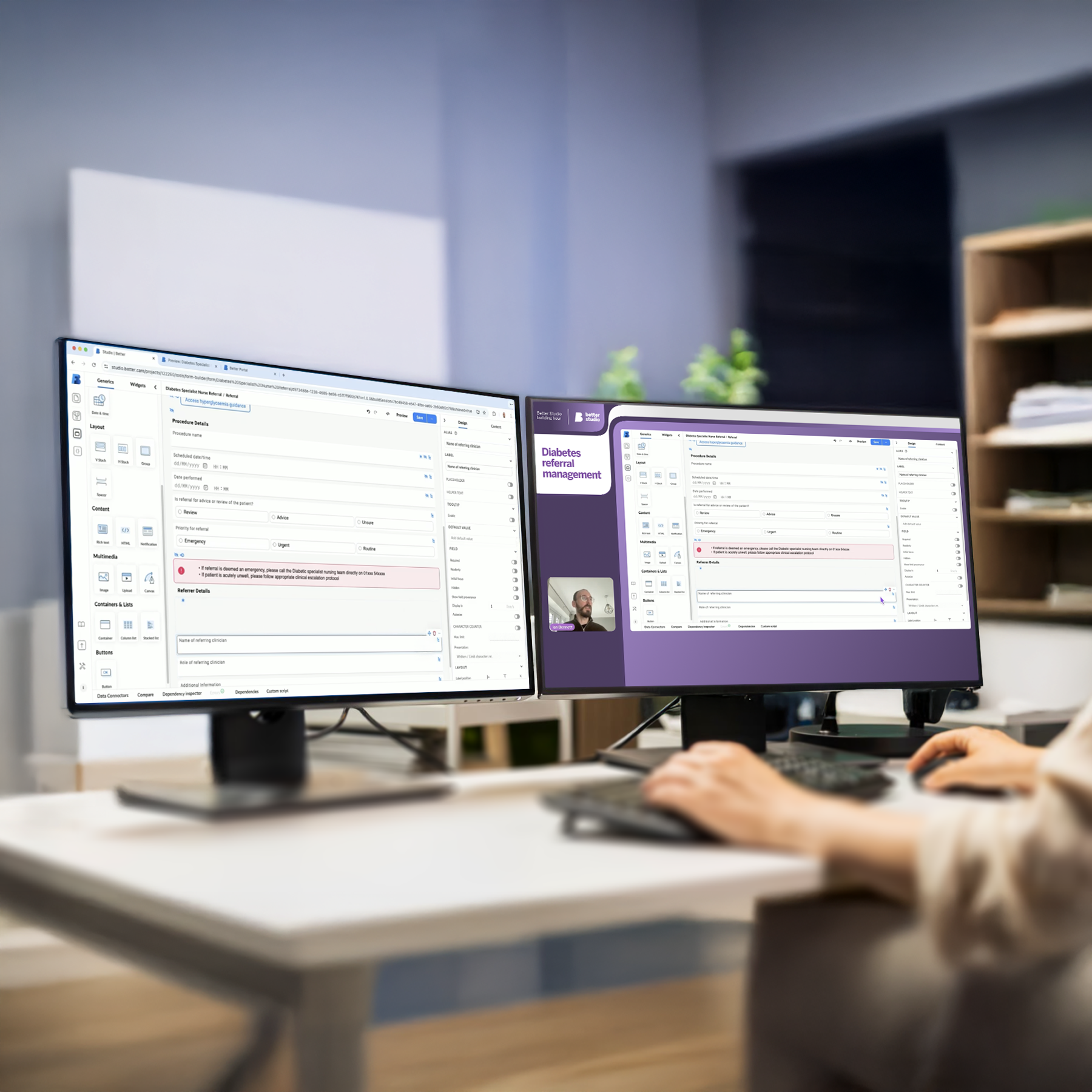
Healthcare organisations are under constant pressure to improve efficiency and deliver better patient care. Every process matters, and every click counts. That’s why we created Studio building hour: A webinar series designed to help you unlock the full potential of Better Studio, the low-code clinical form building tool.
In this first session, we explored diabetes referral management and demonstrated how adaptive forms can transform clinical workflows. But this is more than a recap. It is about why these sessions matter and how they can help you innovate in digital health.
Why we started Studio building hour webinars
Healthcare workflows are often complex, involving multiple steps and stakeholders. For clinicians, administrative tasks can feel overwhelming, taking valuable time away from patient care. Our mission with the Studio building hour series is simple: To help users feel confident in exploring new possibilities with clinical form building in Better Studio and to build a stronger connection with our community.
These webinars are designed to do more than showcase features. They aim to:
👥 Engage both new and experienced users
🧪 Demonstrate practical use cases
💡 Inspire innovation and experimentation
🚀 Identify power users for future user group sessions
Ultimately, these sessions help us improve direct communication with our users, uncover real-world success stories, and create a space where ideas can flourish.
Why adaptive forms matter
Adaptive forms play a central role in this vision. They are not just digital versions of paper forms, they are intelligent tools that respond to real-world needs. By creating forms that adjust based on context, we empower clinicians to spend less time on admin and more time with patients. For patients, this means timely, accurate care and a smoother experience.
Our first webinar focused on diabetes referral management, a process that often involves several specialists and can easily become a bottleneck. With Better Studio, you can design workflows that minimise delays, improve communication, and ensure patients receive timely care.
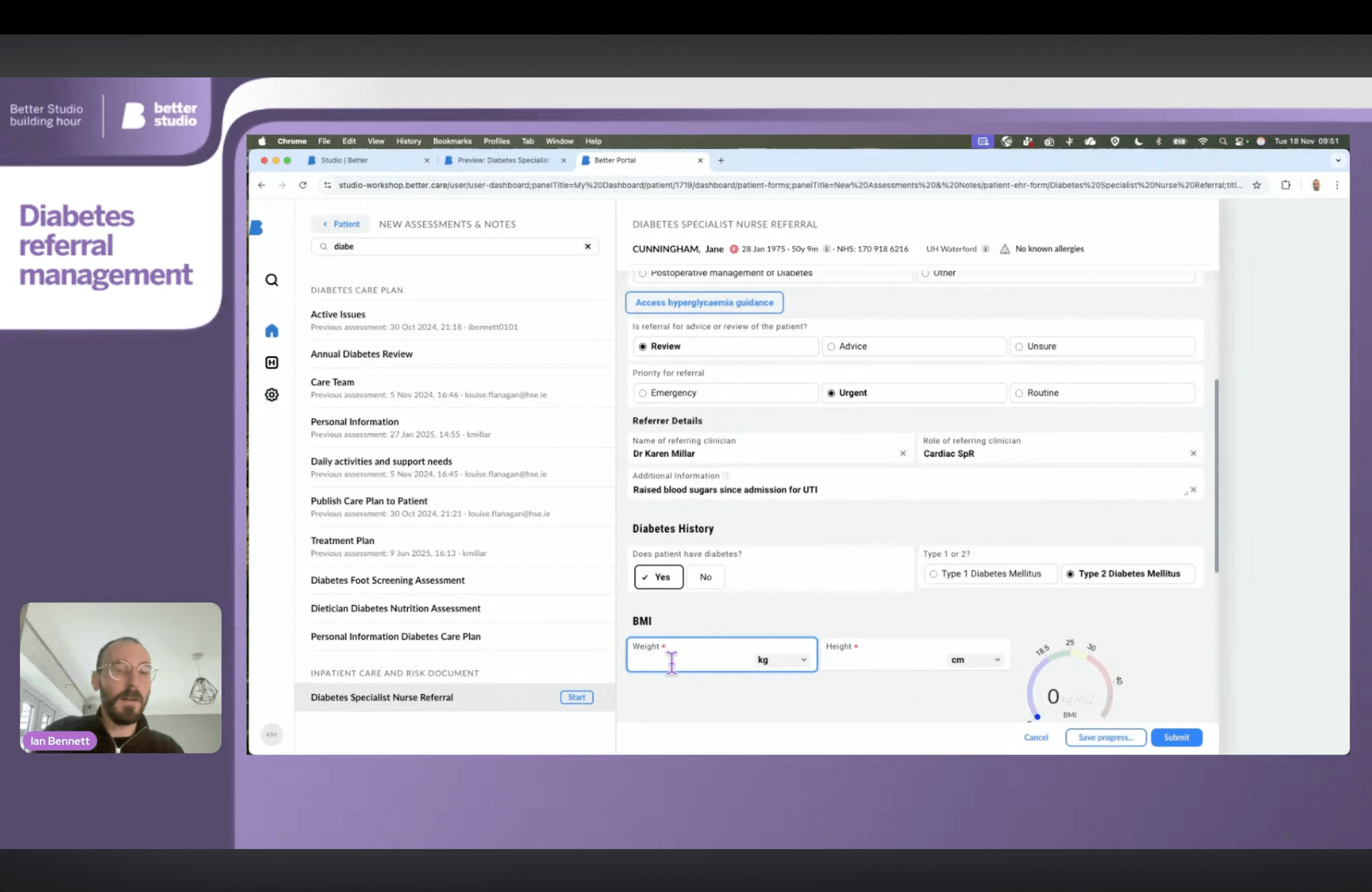
During the webinar, we were able to:
🧠 Build adaptive logic, so patient data automatically determines referral outcomes.
⚠️ Create conditional workflows that trigger alerts for urgent cases.
📝 Use pre-filled fields to reduce manual data entry and improve accuracy.
🔀 Configure dependencies so forms adapt dynamically based on clinician input.
🔗 Integrate with existing systems for seamless data flow and interoperability.
✔️ Showcase real-time validation to ensure data consistency and compliance.
We were able to achieve all of this within the hour, making it an extremely fast form-building process that resulted in a fully functioning clinical assessment.
And it’s not limited to diabetes! These principles apply across countless healthcare scenarios.
What is next
This was the first of many Studio building hour sessions. The next one is coming in January, and we will continue to explore practical examples, new features, and creative ways to use Studio in your organisation.
Future webinars will dive deeper into:
🧩 Building adaptive forms for different clinical scenarios
🔧 Integrating new features into your workflows
📚 Learning from real-world use cases shared by other users
Make sure you subscribe to our newsletter, so you don’t miss the announcement for the next session.
Ready to see it in action?
If you missed the live session, don’t worry! The recording is already available.
And remember, the next Studio building hour is coming in January. Subscribe to stay updated and join the conversation. We would love to see you there.