





Healthcare teams are under constant pressure to deliver safe, timely, and coordinated care. To help them achieve that, we are introducing Connect, a clinical communication capability that replaces fragmented channels with a single, integrated layer.
In our previous post, we explored how clinical communication frequently breaks down because communication is fragmented across phone calls, emails, consumer messaging apps, and handwritten notes. When vital information is forced through tools never designed for clinical coordination, teams are left navigating friction that should not exist.
These challenges compromise care quality and patient outcomes, creating a daily environment of chaos.
The clinician’s daily reality: Collaboration meets chaos
Through extensive interviews with nurses, doctors, and pharmacists, a clear picture of the current clinical communication crisis emerges.
Clinicians waste significant amounts of time chasing colleagues instead of caring for patients — struggling with duplicate messages, unreliable channels, and manual workarounds. In many hospitals, medical staff can spend up to half an hour waiting on hold or trying to locate a specialist in another department.
Because official channels such as pagers and landline phones are often too slow or lack sufficient context, clinicians frequently resort to non-compliant consumer apps like WhatsApp or Viber out of sheer necessity, using them to share clinical information and coordinate care quickly. This creates serious patient safety risks: Informal messages and verbal agreements leave no official record or audit trail, leading to “my word against theirs” scenarios when communication breaks down or errors occur.
Finally, constantly switching between the Electronic Health Record (EHR) and a separate communication tool causes cognitive overload and disconnects vital conversations from actual clinical data.
Introducing Connect: Where clinical communication meets workflow
To address these widespread issues, Better introduces Connect, an integrated clinical communication capability designed to support safe, efficient, and context-aware collaboration across care teams.
Based directly on clinician interviews and market research, Connect is designed specifically for asynchronous and non-urgent communication, while supporting seamless escalation to real-time interaction when required.

Why integration is essential for asynchronous communication
Asynchronous messaging is essential for non-urgent tasks, as it allows clinicians to prioritise immediate care and respond when they are available. However, it becomes a patient safety risk when it exists outside the clinical workflow.
Standalone messaging apps and emails create information silos. If a doctor and nurse discuss a medication change over a private chat, the pharmacist screening the new prescription has no visibility into that decision. This can lead to near-misses and serious patient harm.
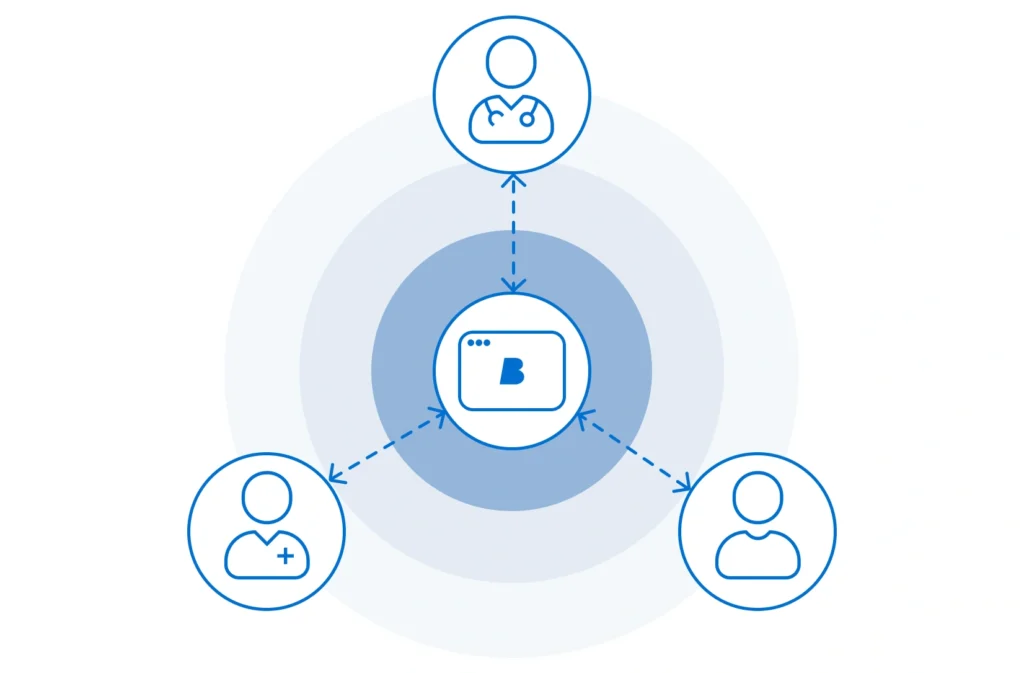
By integrating asynchronous clinical communication directly into the Better Portal data architecture and governance model, Connect ensures that every message is securely tethered to the patient’s record and visible to the appropriate roles. Clinicians no longer need to manually re-type patient histories, and critical context is never lost during shift handovers or cross-departmental consultations.
Industry standards now require that modern platforms become “situationally aware” and “collaborative”, converging secure messaging and voice channels with deep interoperability and real-time patient context. Connect is built to address exactly these core use cases.
How Connect solves the pain points
Connect bridges the gap between the patient’s record and team communication, with features that directly address clinician frustrations.
→ Care team collaboration and secure messaging
Connect delivers secure one-to-one and group messaging for asynchronous communication. By providing a compliant channel, it replaces risky consumer apps entirely, reducing reliance on phone calls and emails while significantly improving coordination and responsiveness.
→ Voice and telephony integration
Text is not always enough. Connect allows teams to seamlessly escalate from messaging to audio or video calls within the same conversation context, minimising time lost switching between different channels.
→ Interoperability and access to critical results
Connect is interoperable by design. Built on openEHR and FHIR standards, clinical communication data is fully structured and linked to authoritative clinical data sources, enabling teams to securely exchange and integrate patient information with point-of-care systems.
→ Permission-aware content sharing
Connect automatically enforces role- and context-based access controls during content sharing. This protects patient data effortlessly, removing both the cognitive and legal burden from clinicians.
→ Patient safety by design
Getting the right information to the right person at the right time is the foundation of patient safety. Connect’s permission-aware, role-based access controls ensure that clinical data is shared appropriately, consistently, and automatically.
The impact: Better collaboration, better care
Connect elevates how care teams communicate by replacing fragmented channels with a single, integrated layer that keeps every message aligned with patient context and organisational standards.
This empowers clinicians to focus on making critical medical decisions rather than wrestling with disjointed tools — supporting faster handovers, clearer responsibilities, and stronger continuity across shifts and departments. The result is reduced duplication of work, fewer interruptions, and meaningfully improved care coordination across teams.
Improving clinical outcomes and equipping clinicians with a single, efficient communications tool should not be a challenge. It is time to move beyond chaotic phone tag and unsafe consumer apps, and to embrace integrated, workflow-driven communication.
—
Better communication starts with the right foundation. See how Connect helps care teams reduce errors, improve coordination, and put patient safety first.