


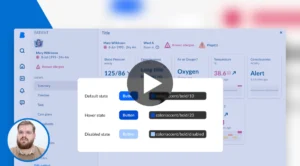


A faster, safer, and more collaborative way to build healthcare applications
Modern healthcare organisations are under immense pressure to deliver digital solutions faster while maintaining strict security, compliance, and usability standards. Traditional software development, with long coding cycles, resource bottlenecks, and costly integrations, often cannot keep up with these demands.
Low‑code development has emerged as a new way to create software that can adapt to the dynamic needs of healthcare delivery. By providing a visual, model-driven approach to application design, low‑code makes it possible to design, build, and deploy new solutions significantly faster – and with a much closer collaboration between IT professionals and the clinicians and staff who actually use these tools every day.
What is low‑code development?
Low‑code development replaces the need for extensive manual coding with visual tools and model-based techniques that make the application building process faster and more intuitive. Instead of writing every single line of code, developers and domain experts can assemble pre‑built building blocks, set up workflows, and define business rules using a drag‑and‑drop interface.
This approach is ideal for healthcare, where the people closest to the workflows – clinicians, care managers, administrative teams – can actively participate in creating solutions that fit their real needs. It also reduces dependency on scarce development resources, allowing digital transformation projects to move forward even with limited IT capacity.
Key characteristics of low‑code development include:

Visual design tools that allow applications to be created using flowcharts and components

Reusable templates and modules that speed up delivery

Automatic generation of integrations and APIs

Rapid deployment and continuous evolution, so applications can be released quickly and refined continuously
Why low-code matters for healthcare?
Healthcare systems are constantly evolving. New care pathways, new regulations, and new expectations from clinicians and patients mean that software must be adaptable and responsive.
Low‑code development directly addresses these challenges by:
- Shortening development timelines from months or years to just weeks
- Empowering clinicians and non-technical professionals to collaborate with IT teams in building apps
- Reducing the cost and risk of experimentation, making it feasible to create small apps, test them in practice, and improve them continuously
- Allowing organisations to keep pace with change, without relying on costly and inflexible legacy systems
The result is a faster and more inclusive way to innovate – a model that matches the speed and complexity of modern healthcare.
Accelerate your organisation’s innovation capability with low-code.
Low‑code within Better Digital Health Platform
When combined with a Digital Health Platform (DHP), low‑code development becomes even more powerful. This approach dramatically reduces the complexity of app development, allowing developers to focus on creating functionality and user experience rather than worrying about data structures and integrations.
The DHP provides a secure, standards-based foundation for data and interoperability, which means that applications created with low‑code tools:
- Work directly with a shared clinical and operational data layer
- Clinical data repository (openEHR): persistent and structured clinical data
- Operational data repository (FHIR): demographic, administrative and workflow data
- Use APIs, microservices, and events to access data and services securely
Developers can subscribe to clinical and operational events, integrate seamlessly with other applications, and react in real time. - Integrate fully with terminology services
Built-in support for SNOMED CT, LOINC, ICD, and other terminologies guarantees semantic consistency across all apps. - Inherit advanced governance and security mechanisms, including attribute-based access control (ABAC), auditing, and role management.
Beyond these technical foundations, the Better digital health platform offers a healthcare-specific ecosystem that accelerates development even further:
- Pre-defined data models through openEHR archetypes and templates mean data is immediately usable.
- A healthcare design system and UI component library ensures that applications look and behave consistently in a clinical setting.
- Marketplace with ready-made content and workflows, including dashboards, timelines, and forms, can be configured and adapted rather than built from scratch.
- Clinical portal with pre-configured patient baner, patient lists, forms, summaries and dashboards and more so you can start production use immediately
Teams can focus entirely on building functionality, user experience, and value for clinicians and patients instead of spending time on data structures and integrations.
The role of low‑code in a Postmodern EHR
A postmodern EHR combines legacy systems, modular applications, and a shared open platform. Low‑code development is a key enabler of this model:
- New functionality can be built as independent modular apps, without replacing core systems
- Clinicians and IT teams collaborate directly, ensuring apps reflect real workflows
- Innovation cycles become much shorter, so organisations can adapt to changing requirements
- Applications are interconnected through open data standards, avoiding data silos and duplication
Low‑code development transforms the postmodern EHR into a flexible and evolving ecosystem that grows with the needs of the organisation.
Comparison: Better low-code vs. generic low-code
Feature / Capability
Better Studio
Generic low-code platforms
Domain focus
Purpose-built for healthcare and regulated environments
General-purpose, requires healthcare adaptation
Data foundation
Works with openEHR CDR & FHIR ODR (clinical and operational data)
No native healthcare data support; requires custom integrations
Compliance & security
Flexible ABAC for privacy, audit, GDPR and healthcare compliance
Generic security; healthcare compliance requires additional work
Reusable components
Ready-made healthcare UI components, widgets and forms
Generic UI components with no healthcare context
Healthcare design system
Award winning design system for healthcare workflows and UIs
No healthcare-specific design elements
Clinical portal
Pre-built portal with patient banner, lists, dashboards and more
Needs to be developed from scratch
Clinical knowledge database
openEHR templates and FHIR resources are ready out of the box
No embedded healthcare knowledge; requires manual modelling
Healthcare marketplace
Growing ecosystem of healthcare apps and components
No dedicated marketplace for healthcare
Integration
Native support for standards: FHIR, HL7 v2, SNOMED CT, LOINC, ICD
Generic connectors; healthcare standards need manual work
Collaboration
Clinicians, developers and analysts co-create apps and workflows
Collaboration requires significant IT mediation
Innovation speed
Rapid delivery based on modelled healthcare data
Slower – healthcare-specific models need to be built manually
Scalability
Proven national-level implementations
Scalability is generic, but without healthcare-specific optimisations
Benefits of low-code development with Better
Speed of delivery
Solutions delivered in hours instead of months.

Collaboration between IT and clinicians
Solutions are designed by those who use them

Compliance out of the box
No need to reinvent standards or compliance frameworks
Scalable modularity
Applications can grow from small departmental tools to enterprise-wide or national solutions

Modern user experience
Built with a healthcare-specific design system

Ready-made content
Templates, clinical components, workflows, and connectors are available from day one
Ready to simplify healthcare solution development?
Start building your next healthcare solution faster and safer with low-code.
