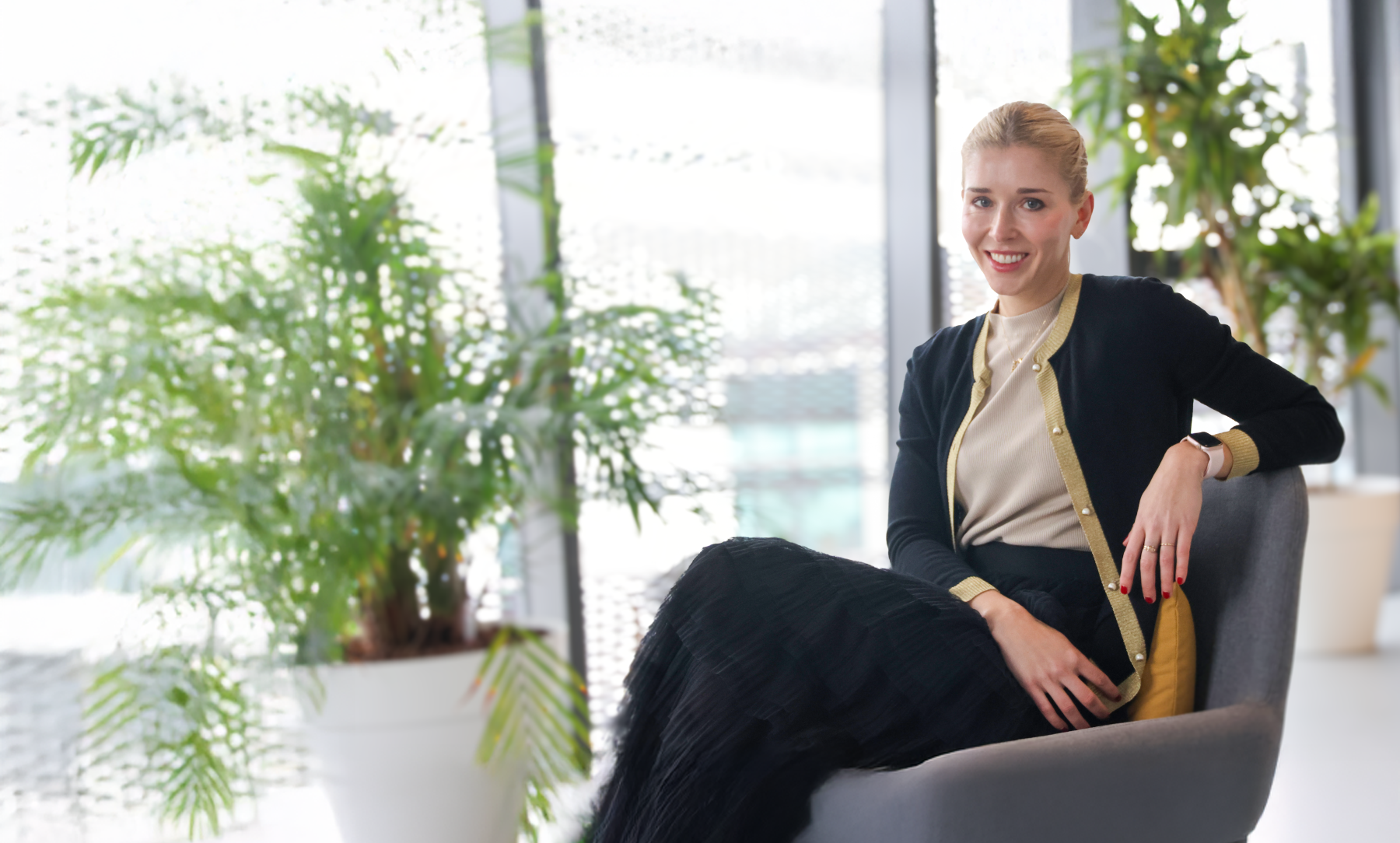


“My goal is to help design software that minimises friction, enhances workflows, and feels kind and supportive,” Barbara Hiti said when asked about the impact she wants her work to have.
Barbara is a product analyst on our Better Meds team who shifts between the roles of a UX researcher, project manager, and business analyst, “whatever is needed to make the solution successful”. “I can’t stand poor user experience or poorly designed solutions, but I do believe that practicality and resourcefulness are among the most important qualities of any good designer or problem solver,” she said and explained her philosophy behind design. Barbara is a very thorough and attentive person, who finds Better to be her lifetime opportunity “because we have what it takes to achieve excellence in user experience in our healthcare products and solutions”. Get to know Barbara in the interview below.
What are your primary responsibilities as a product analyst for Better Meds? What does your typical day at Better look like?
When we, as product analysts or product managers in the Better Meds team, are tasked with a particular problem or topic, this means we own it in a way to take responsibility for managing the whole process from problem research to the handoff of specification to development and support through the development and testing phase. Depending on the project phase, my role shifts from UX researcher to project manager to business analyst, whatever is needed to make the solution successful.
We typically get tasked with either a defined improvement opportunity or research on a broader topic to uncover new ones. We mostly use qualitative research techniques and try to include information from multiple sources — stakeholders and user interviews, user groups, support tickets, tender requirements, market trends, and competitor analysis.
Once opportunities for improvement are identified, we categorise them by complexity: quick wins that improve existing features or larger efforts requiring new functionalities or modules. The process for quick wins is different from new functionalities, but each path involves design, internal clinical validation, feasibility checks with developers, and user feedback. The goal is to find the sweet spot: bring maximum user value, use minimal development effort, and create a strong business impact as a result. Once aligned both internally and with users, we draft a development specification, which is later refined with technical input from the development team.

You started at Better in UX design and then transitioned to a product analyst. What motivated that transition, and how do those two perspectives complement each other?
It is not about the role title, but the impact I can have to co-create quality solutions. UX designers are not always seen as equal team members or problem solvers. Instead of being involved from the start of the project, we are often brought in at the end, after developers and product or business analysts had already shaped the solution, and expected us to “style” it. This approach leaves designers out of the critical solution-shaping phase, which should be a collaborative effort involving users, designers, developers, and analysts to create a solid blueprint.
When the Better Meds team invited me to join as a product analyst, I saw it as an opportunity to have better access to users and a greater impact in shaping the user experience. This role allows me to conduct research while collaborating closely with excellent designers and developers during the solution shaping phase. My background in UX helps bridge the gap between research findings and design solutions, and I feel I am better suited to this space, contributing meaningfully to both parts of the “equation”.
How does your background in visual communication influence the way you approach complex clinical content and healthcare software design?
I can’t stand poor user experience or poorly designed solutions, but I do believe that practicality and resourcefulness are among the most important qualities of any good designer or problem solver.
Through design studies and art history, I have learned that many great designers thrived by repurposing everyday materials or leftovers in ingenious ways. One of my favourite examples is Jože Plečnik, who famously used coloured drinking glasses to create a chandelier in the church (St. Michael in Črna vas, Ljubljana), a beautiful response to limited resources. His work reminds me that great design isn’t necessarily about novelty but transforming what we already have into something meaningful with minimal intervention.
That is exactly what inspires us while redesigning legacy parts of Better Meds: finding potential in small improvements, quick wins, and creative reuse. But sometimes, you encounter a problem when an elegant and lean solution simply isn’t possible. Those are my most painful moments, and they keep me awake at night.
Collaboration is key to your role. What do you value most in cross-functional teamwork, especially when working with developers, clinicians, and product managers?
During my onboarding, our product lead said, “Together, we know everything.” And it is true, I have never encountered so much knowledge in one place. I rely daily on the support of our clinical, product, and development teams, as well as our dedicated users, who shape our roadmap and guide our next steps.
I am especially grateful to my mentor, Angela White, our product team lead, Rok Lenart, and our incredible developers, who also have deep knowledge of clinical workflows and sharp product thinking. I keep learning from them every day.
You believe digital solutions can reduce errors in healthcare. In your experience, what are some of the most important aspects of designing digital tools for healthcare professionals?
Reducing medical errors is one of the core goals of choosing an ePMA like Better Meds. Our product already supports this through integrated clinical decision support, maximum dosage warnings, and more. To design effective tools, we need to learn from real incidents and near misses, understand why some complex prescribing and medication administration records still rely on paper, and address those gaps.
One aspect that is particularly unique to healthcare products is the shared responsibility between the app and the user. We aim to strike a balance between alert fatigue and providing consistent, meaningful decision support.
What kind of impact do you want your work to have, not just within Better, but in the broader healthcare ecosystem?
I have deep respect and gratitude for healthcare professionals, as their dedication has personally touched me and my family. Witnessing the immense pressure they face motivates me to create solutions that make their work easier. I believe apps are like people: they can be kind and supportive or harsh and unempathetic. My goal is to help design software that minimises friction, enhances workflows, and feels kind and supportive.
Healthcare apps have fallen far behind other industries. Meanwhile, the apps we use in everyday life for exercise, communication, project management, image editing, and social media are continually improving in usability and delight. I hope we can bring some of that level of user experience and joy into our B2B clinical products.
What do you think healthcare software will look and feel like 10 years from now, and what role do you want to play in shaping that future?
In 10 years, we should see a more personalised approach to treatment and care, supported by genetic analysis. This will enable clinicians to predict treatment effectiveness for each patient and become part of decision support. I believe AI will gain greater trust, backed by clearer legal regulations. It will play a key role in interpreting unstructured, migrated, and integrated data, reducing the need for manual cleaning, mapping, or transcription.
Voice control will assist with navigation and data entry, while AI-generated summaries based on user prompts should greatly reduce the time spent searching and reviewing patient records. AI agents will handle workflow orchestration, creating tasks, triggering events, and supporting decisions, lowering cognitive load and reducing manual effort. Logins may eventually be replaced by facial recognition. Most tasks should adopt a mobile-first approach.
I can hardly wait to start working on those proof-of-concepts and pilot projects to help make this vision a reality.
When you think about your career so far, what is the most important and valuable lesson you have learned?
I have learned to be proactive and not wait for step-by-step direction. I have also realised the value of asking colleagues for information. There is a lot of in-house knowledge, even if it’s not centrally documented. To make good product decisions, I believe you need to understand four perspectives: user, design, technical, and business. I feel quite confident in the first two but still rely on colleagues for the technical and business sides.
What inspires you outside of work? Are there particular hobbies that keep you curious?
I make time to learn about healthcare, design, and product development. To balance the complexity of my work, I value simplicity – gardening, nature walks, and time with family, away from screens.
What does Better mean to you?
A lifetime opportunity – I think we have what it takes to achieve excellence in user experience in our healthcare products and solutions and make clinical workers’ and patients’ lives easier.