


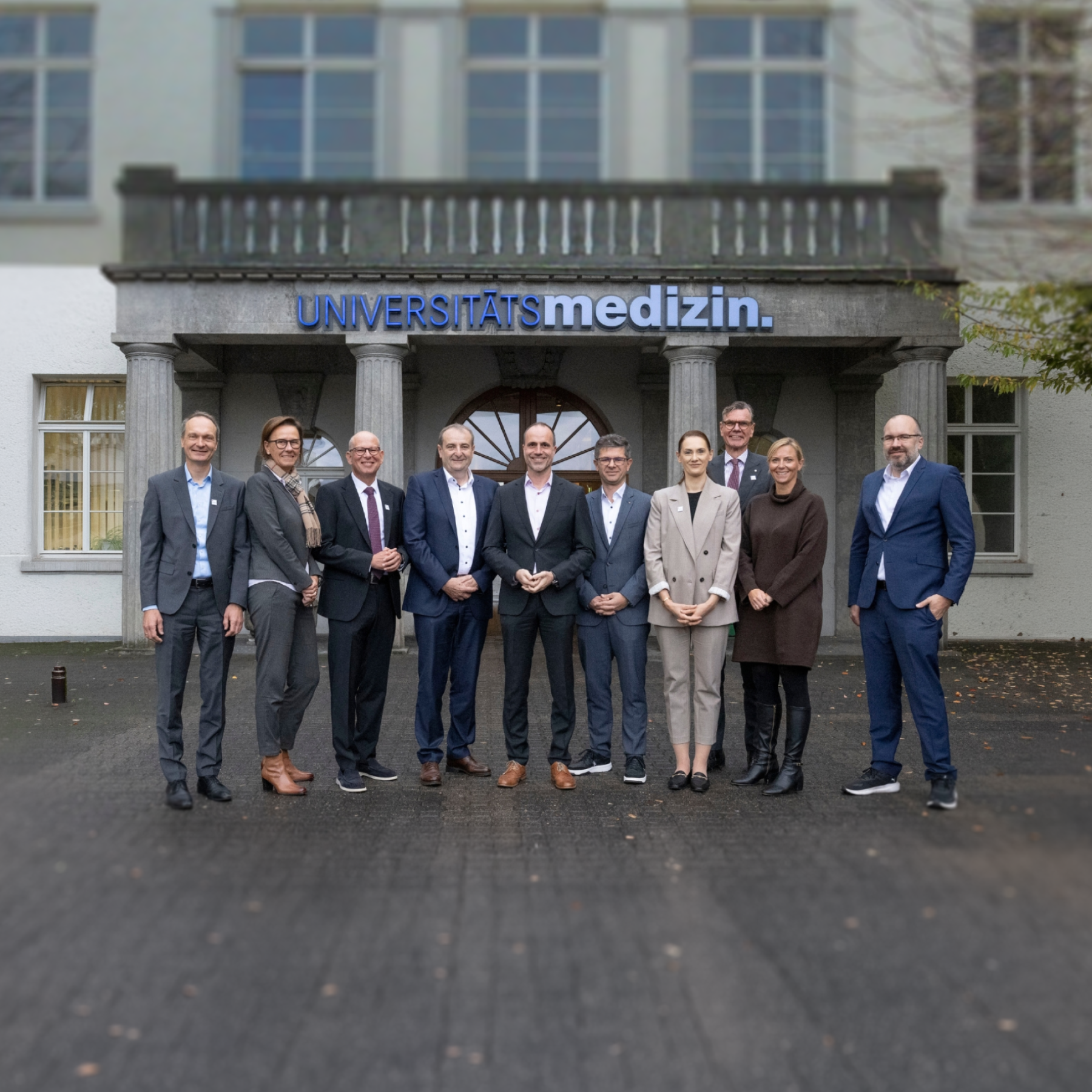
Open clinical data platform sets a new benchmark in digital hospital transformation
Digitalisation at the University Medical Center Mainz (UM), as part of its future programme UM.Digital, has reached another important milestone: as one of the first German university hospitals, UM is introducing a Clinical Data Repository (CDR) not only for research but for patient care as well.
The vendor-independent data platform “UM.Core” will bring together patient data from UM’s various clinical IT systems and make it available across systems. This enables a more unified and comprehensive, hospital-wide view of patients and their course of treatment, and increases efficiency in everyday clinical work. The project is being delivered by an all-European partner consortium of x-tention, Better and Tieto Caretech.
At the University Medical Center Mainz, more than 60 clinics, institutes, and departments work together across disciplines in 11 divisions, treating around 395,000 inpatients and outpatients each year. UM’s clinical IT landscape is highly specialised and has grown over many years. Relevant patient data is generated in different systems, depending on the focus of each specialist clinic. With the rapidly advancing digitalisation of a university medical centre, linking and providing data had become increasingly complex.
For this reason, the University Medical Center Mainz, as one of the first university hospitals in Germany, decided to introduce a Clinical Data Repository (CDR) explicitly for patient care, in which clinical data is brought together and consolidated in a structured manner. Through “UM.Core”, those involved in a patient’s treatment can retrieve relevant patient-related data in a structured form at a glance – easily, efficiently, and securely. This reduces time spent searching, improves the basis for decision-making, and strengthens patient safety. Significant synergies also arise for research.
“UM.Core aims to make clinical data available in a CDR in the most highly structured form possible, enabling a more unified view of patients and their course of treatment. At the same time, the platform’s open architecture offers the potential for better connectivity and more collaboration in patient care and research,” explains Univ.-Prof. Dr Ralf Kiesslich, Chairman of the Board and Chief Medical Officer of the University Medical Center Mainz. He emphasises: “I am delighted that we are introducing the CDR explicitly for clinical patient care as well. In doing so, we are pioneers in Germany and are actively shaping the medicine of the future.”
“Within our future programme UM.Digital, the UM.Core project makes an important contribution to digital sovereignty, quality of care and excellent research. Beyond that, the CDR forms the basis for a future data-centric, platform-oriented IT landscape at our site. With a sustainable operating model, our IT division is also rising to the challenge of growing competition for skilled professionals,” adds Stefan Smers, Head of the IT Division at UM.
Data from different systems brought together
Specifically, “UM.Core” brings together data from various source systems in near real time, structures it and visualises it centrally in a single interface. The data also remains in the source systems, such as “COPRA”, meaning it is held redundantly. As a result, the data no longer exists only in isolated, vendor-specific systems, but additionally in an open, standardised data platform. This forms an important pillar of a future-proof downtime and contingency concept. In this way, UM is deliberately securing its own long-term, vendor-independent sovereignty over sensitive clinical data.
“UM.Core” is operated by the external IT service provider x-tention as a managed service in a certified private health cloud. The technological foundation for open, standardised data storage is provided by Better Platform. Tieto Caretech contributes the Lifecare Open Platform and SmartUI, providing the components for role-based clinical views and user-oriented applications. Data in the CDR is stored in openEHR, an international standard for developing interoperable application systems, designed for lifelong data storage. Standardised Fast Healthcare Interoperability Resources (FHIR®) are used to transmit data from the source systems. The data streams from the source systems are integrated via MACH | Orchestra. Clinical project management and the clinical validation of the data building blocks are the responsibility of the University Medical Center Mainz.
“The trust that the University Medical Center Mainz has placed in us is both an incentive and an obligation,” says Herbert Stöger, Managing Director and founder of x-tention. “By building a vendor-neutral data platform, the hospital is taking a step that we consider groundbreaking – not only for its own institution, but for the entire hospital landscape. Together with our partners Better and Tieto Caretech, we are convinced: the future of clinical IT lies in open data platforms.”