



A radiologist dictating the day’s reports, a clinician seeing a patient in an outpatient consultation, a hospital doctor moving from bed to bed on the morning ward round. Each generates clinical documentation, but not in the same way. When documentation depends on typing or writing information up later, it can compete with clinical work for time and attention.
The answer is not simply to replace typing with one alternative. Different clinical settings call for different ways of capturing information. Invox Medical, a clinical documentation platform using speech recognition and AI, is now available on Better Marketplace, with tools for reporting, consultations, and ward rounds.
Why does one approach to clinical documentation not work everywhere?
Medical dictation is well suited to situations where the clinician is intentionally composing a report. A radiologist or pathologist can describe findings as they work rather than type them afterwards, making spoken input a natural fit for reporting. A consultation is different: clinically relevant information emerges through conversation, so asking the clinician to dictate a separate account afterwards still leaves documentation as an additional task. Ambient documentation can instead use the conversation itself to produce a draft note.
Neither model maps perfectly onto every setting. During a ward round, clinicians move between patients and information is generated at the bedside rather than through a formal report or a single consultation at a desk. The useful question is therefore not simply whether speech can replace typing, but which way of capturing spoken information best fits how the clinical information is being created.
How can AI medical documentation fit different workflows?
Invox Medical treats reporting, consultations, and ward rounds as distinct documentation processes, using a different approach to spoken input for each:
- Invox Dictation for clinical reporting: real-time medical speech recognition turns dictated speech into text wherever the cursor is positioned, including within systems such as RIS, PACS, LIS, or HIS. Specialty dictionaries, custom vocabulary, voice commands, and templates can adapt the process to different types of medical reporting.
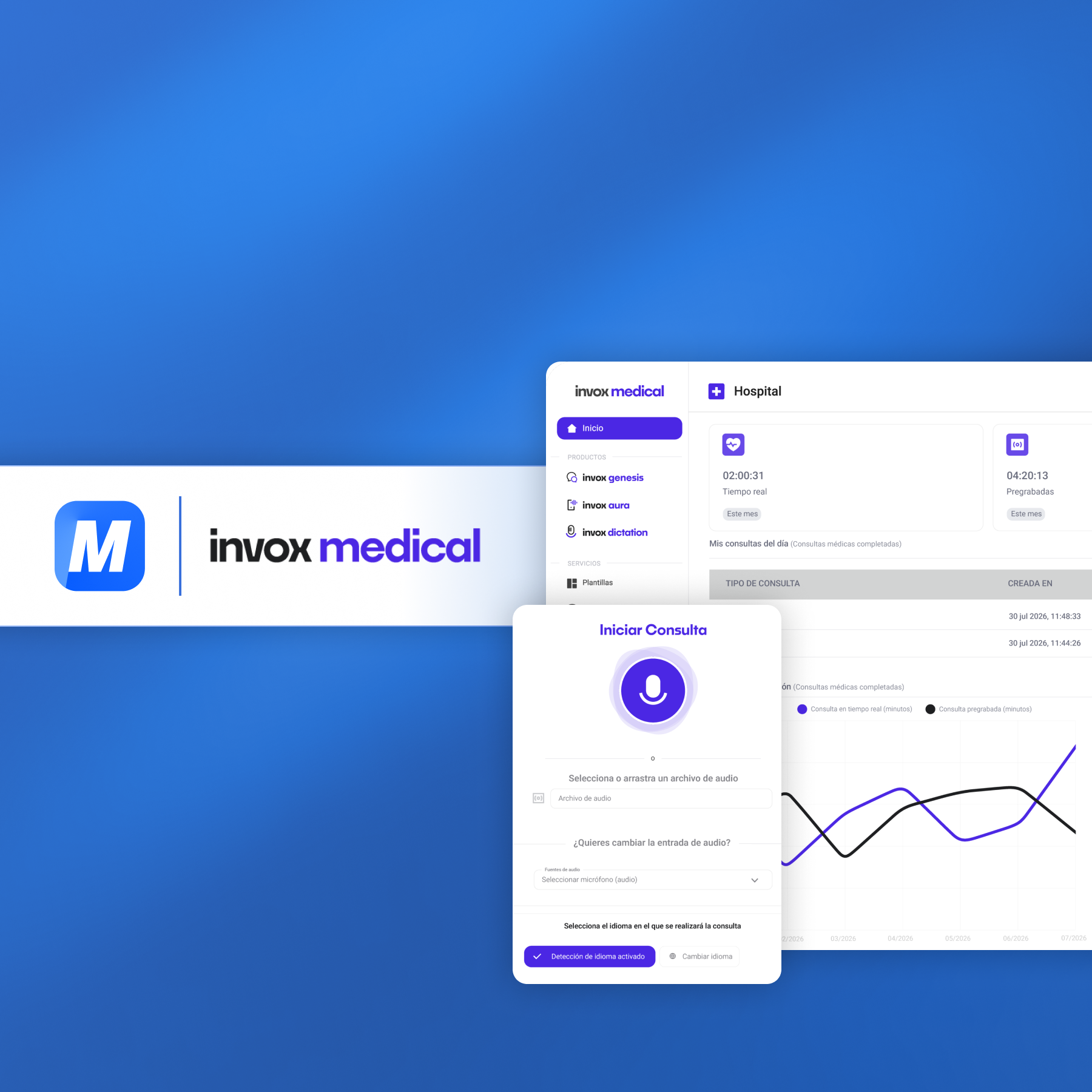
- Invox Genesis for consultations: ambient AI captures the clinician-patient conversation, identifies the speakers, and proposes a clinical note based on the healthcare organisation’s own template. Information can be organised into sections such as the reason for consultation, personal history, diagnosis, and treatment plan.
- Invox Aura for ward rounds: a mobile application allows clinicians to identify the patient by QR code or ID, capture the bedside conversation, and generate a summary note for later review on desktop before it is sent to the clinical record.
Spoken input is common to all three, but the way that speech becomes documentation changes with the clinical setting. The aim is not to apply one documentation method everywhere, but to use the form of capture that best matches the work taking place.
What does voice technology need to get right in healthcare?
Moving from typing to speech only helps if the technology can cope with the language and clinical context in which it is used. Healthcare adds complexity that general-purpose speech recognition may not be designed for, including specialist terminology, regional accents, local language use, and differences between specialties. Invox Medical supports Spanish, Portuguese, Brazilian Portuguese, Catalan, Basque, and Galician, including regional accents. Invox Dictation also includes dictionaries for more than 15 medical specialties, alongside custom vocabulary and templates, while Genesis can automatically detect the language being spoken during a consultation.
Recognition is only one part of the problem. The resulting documentation still has to be clinically reviewed and reach the systems where it belongs. Across Invox Medical, generated documentation remains a draft until the clinician reviews and validates it. Genesis allows the proposed note to be edited and supplemented through dictation, while Aura produces a ward-round summary for review before it reaches the record. Invox Dictation can work directly within systems such as RIS, PACS, LIS, and HIS, while Invox I/O provides APIs, SDKs, and webhooks for connecting Invox capabilities with existing technology. Genesis can also be launched from within the host EHR, and Invox Medical can be deployed in the cloud or on premise.
From spoken clinical work to the clinical record
Clinical information is created in different ways, from diagnostic reporting and patient consultations to conversations at the bedside. Effective documentation needs to reflect those differences while still producing information that clinicians can review and add to the clinical record.
At Better, we believe healthcare technology should fit around clinical work rather than force clinicians to work around technology. Invox Medical supports that vision by adapting voice-based documentation to different clinical settings, keeping the clinician responsible for the final record, and helping the resulting documentation remain close to the systems already in use. By bringing dictation, ambient documentation, and ward-round capture into one platform, Invox Medical adds another way to reduce the burden of documentation across clinical settings.
Discover Invox Medical on Better Marketplace.
About Invox Medical
Invox Medical is a voice and AI documentation platform for healthcare, covering real-time medical dictation, ambient consultation documentation, ward-round capture, and tools for connecting those capabilities with existing clinical software.
Partner with Better
Access a growing healthcare ecosystem built on open standards and expert support.