




A hospital research team may need to answer questions such as: how many of our patients have stage IV non-small cell lung cancer (NSCLC), an EGFR mutation and an ECOG performance status of 0 to 1? The hospital may already have treated those patients and documented each of those details, but much of that information sits in clinic notes, pathology reports and other free-text documents rather than structured fields. Answering population-level questions like this can still mean opening records one at a time.
Savana’s DeID Station for clinical data de-identification, now available on Better Marketplace, helps healthcare organisations meet this challenge. Using clinical natural language processing (NLP), it identifies personal information in structured data and free-text documents and masks or replaces it. Configurable processing options and reviewable results help hospitals and research teams prepare clinical information for secondary use while retaining control over how sensitive data is handled.
Why is clinical free text difficult to de-identify?
In structured datasets, personal information is often stored in clearly defined fields, such as patient names, dates of birth or identification numbers. Clinical narratives are more complicated. A discharge summary, consultation note or referral letter may contain identifying details throughout the text, mixed with descriptions of symptoms, diagnoses, treatments and clinical decisions.
These details do not always follow predictable patterns. Rules and pattern matching can identify common formats, such as telephone numbers or labelled fields, but may miss a physician’s name within a sentence or a hospital mentioned in passing. Recognising this information in context requires an understanding of clinical language, not just predefined patterns.
Removing too much information, however, can undermine the value of the record. Dates, locations and relationships between events may be relevant to understanding a patient’s condition or treatment. Effective de-identification therefore needs to balance protecting identities with preserving clinically meaningful content. Doing this manually across large volumes of historical records is time-consuming and difficult to scale. A single overlooked identifier can also compromise the suitability of a dataset for secondary use.
How does DeID Station prepare clinical data for reuse?
DeID Station is built on Savana’s clinical NLP, trained exclusively on electronic health records and available in seven languages. This allows it to recognise identifying information as it actually appears in clinical writing and apply configurable de-identification strategies. It supports structured and unstructured files, including CSV, JSON, XML, TXT, PDF, DOCX and HTML.
The process consists of four main steps:
- Selecting the data: Users create a processing job and upload the clinical files they want to de-identify, including structured datasets and free-text documents.
- Identifying personal information: The system detects categories of potentially identifying information, including names, dates of birth, addresses, contact details, hospitals and identification numbers. Users select which entity types should be processed.
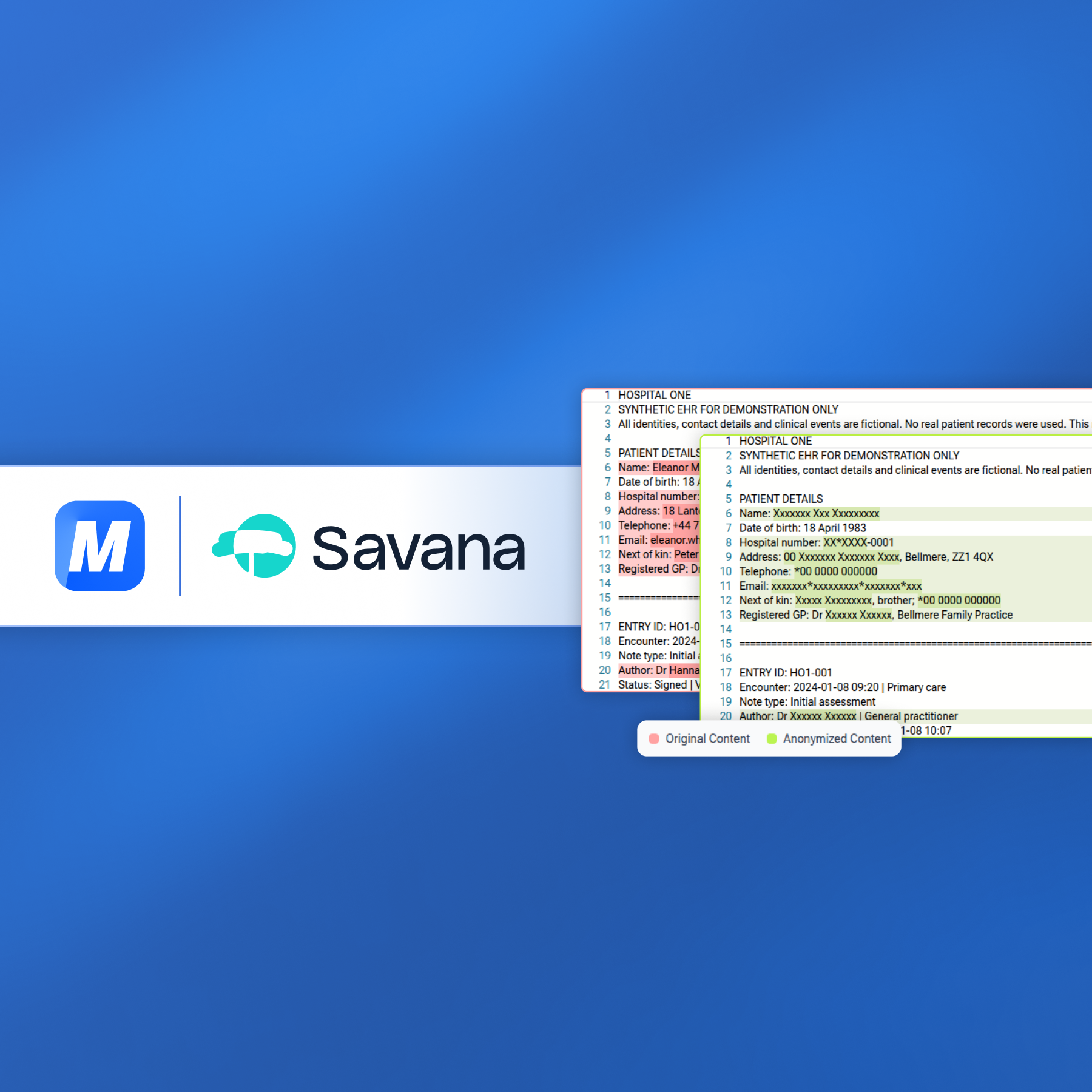
- Applying de-identification strategies: Detected information can be obfuscated with a mask, replaced with a random surrogate that preserves its format, or substituted with a label indicating the entity type. A person’s name, for example, could become XXX, a fictional name or a label such as PER.
- Reviewing the results: The original and processed documents are displayed side by side, with changes highlighted. Counts of detected entities by category help users examine what has been identified and modified.
The choice of strategy lets organisations adapt the output to its intended use. Masking or entity labels may be appropriate when the original values are unnecessary, while fictional substitutes can preserve the structure and readability of a clinical narrative. These approaches can support anonymisation and pseudonymisation workflows, although the status of the resulting dataset depends on the wider risk of identifying individuals, not the replacement method alone.
Making de-identification transparent and reviewable
For hospitals and research institutions, de-identification is not only a technical task. Data governance teams also need to understand how sensitive information has been processed and assess whether the resulting dataset is suitable for its intended purpose.
DeID Station’s comparison view and entity counts support this oversight by making the changes visible. Rather than relying on automated processing without insight into its results, teams can inspect the output and identify areas requiring additional review. This is particularly valuable with clinical narratives, where personal information may appear in unexpected contexts.
The solution also supports on-premises deployment, allowing organisations to process sensitive records within their own infrastructure. Its configurable approach accommodates different document types and clinical writing styles. For hospital IT and innovation teams, these capabilities help establish de-identification as a defined step in preparing clinical data for research, analytics or collaboration with life sciences partners, rather than a manual task repeated for each project.
Supporting research with de-identified clinical data
Clinical notes and reports capture details about symptoms, treatments, disease progression and outcomes that may not be fully represented in structured data. Making this information available for research, analytics, education and quality improvement can provide a more complete understanding of real-world patient care.
DeID Station addresses an important barrier to that reuse by helping organisations protect identifying information without unnecessarily removing the clinical detail researchers need. By combining clinical NLP with configurable de-identification and reviewable results, it supports the preparation of existing records for further use.
At Better, we believe healthcare data should remain accessible, reusable and under the control of the organisations responsible for it. Savana’s DeID Station supports this vision by helping healthcare providers prepare sensitive clinical information for responsible secondary use.
Discover DeID Station on Better Marketplace.
About Savana
Savana is a healthtech company delivering scientifically validated, multilingual clinical NLP trained exclusively on electronic health records. Its technology helps hospitals, HTA bodies, pharma and MedTech companies generate real-world evidence from existing clinical data, and powers the Smart Health Alliance, a global network of hospitals.
Partner with Better
Access a growing healthcare ecosystem built on open standards and expert support.