
A single NT-proBNP cut-off does not fit every patient. Age, renal function, body mass, sex, and clinical context can all influence how a result should be interpreted. Now listed on Better Marketplace, the NT-proBNP Adjusted Risk Threshold module by DryLabz demonstrates how structured patient data and clinician-defined rules can support patient-specific threshold adjustment while making the underlying logic visible.
Developed from work on the RADICAL engine and an openEHR-based use case with University Hospital Basel, the module offers an emerging example of how clinical decision support can become more transparent, inspectable, and governable within hospital workflows.
Why does NT-proBNP interpretation need patient context?
NT-proBNP is widely used in heart failure evaluation, but its interpretation is not one-size-fits-all.
Clinicians routinely consider the result alongside information already available in the patient record. When this judgement is applied manually, similar clinical factors may be interpreted or weighted differently across clinicians, teams, and departments. The reasoning behind an adjusted threshold may also be documented inconsistently.
For clinical informatics teams and healthcare organisations, this creates a wider challenge. It can be difficult to review how the logic was applied, maintain it over time, or explain how a particular interpretation was reached.
The question is therefore not only which threshold should be used. It is also how the clinical logic behind that threshold can be made transparent, consistent, and governable.
How does the module make clinical logic visible?
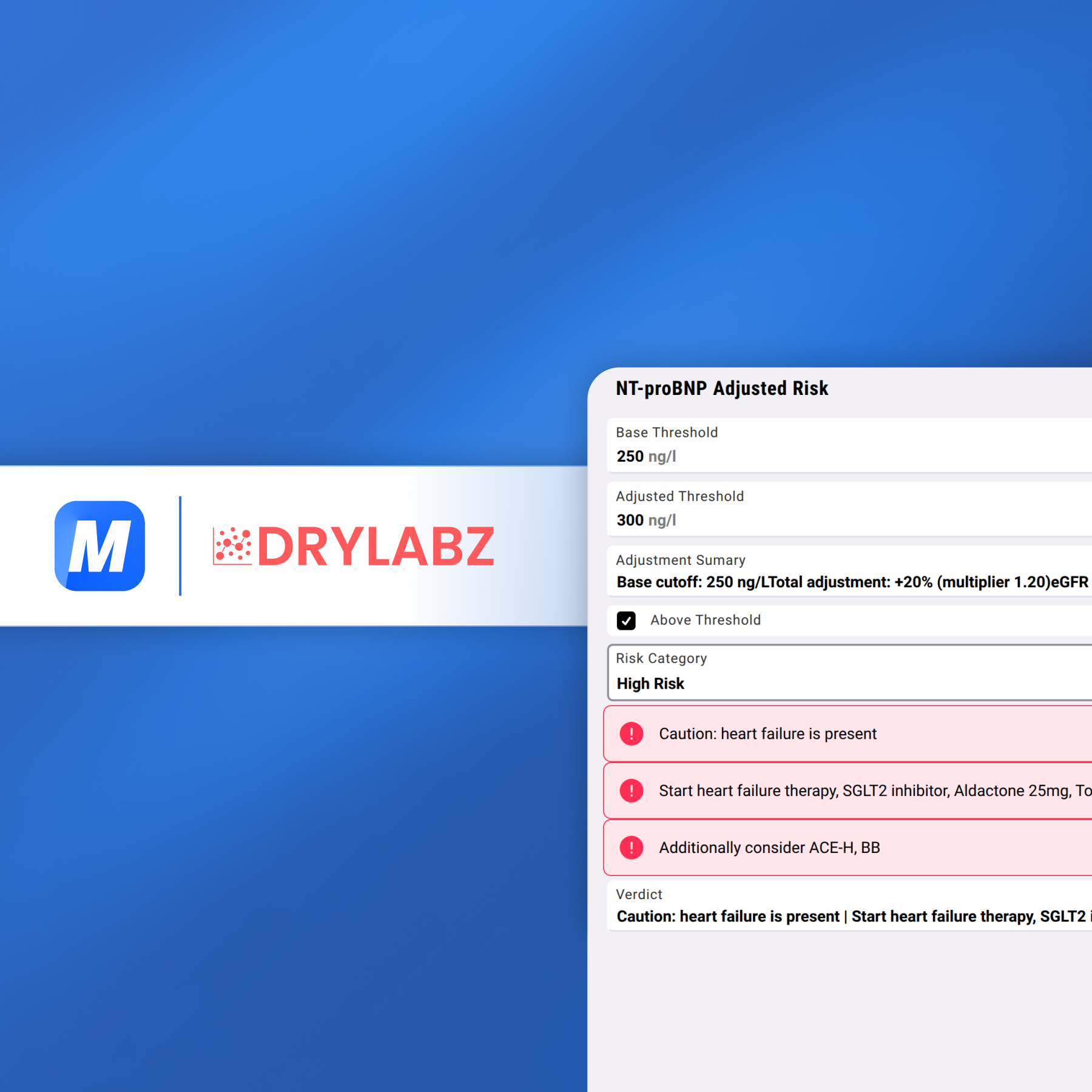
The NT-proBNP Adjusted Risk Threshold module combines the patient’s NT-proBNP value with relevant clinical context and applies transparent, clinician-defined adjustment rules. Its output is designed to show the patient-specific cut-off, interpretation flags, and the logic behind each adjustment.
Rather than presenting only a final number, the module demonstrates how clinical teams could inspect the reasoning behind the result and use it alongside clinical judgement. The goal is not to replace clinician decision-making. It is to make clinical logic more visible, inspectable, and governable within the hospital workflow.
This matters because clinical decision support is not only about what is calculated. Healthcare organisations also need to understand who owns the logic, how it is validated and updated, how changes can be traced over time, and whether they can explain how an interpretation was reached. By keeping the adjustment rules visible, the module offers an emerging example of how hospitals could retain oversight of the logic used in clinical decision support rather than relying on calculations they cannot inspect directly.
The module should currently be understood as an emerging clinical decision support concept for evaluation, pilot collaboration, and discussions about institutional implementation. It is not a standalone diagnostic service and does not replace clinical judgement.
From an openEHR use case to governed clinical logic
The module builds on work by DryLabz on its RADICAL (Regulatory-compliant Algorithmic Diagnostics Integration for Clinical Accuracy and Logistics) engine, currently in development .
During the Digital Health Nation Open Innovation Challenge with University Hospital Basel, DryLabz explored how rule-based diagnostic calculators could run against structured clinical data in an openEHR-based environment. The NT-proBNP use case was proposed and shaped with Professor Christian Müller, Chief Physician Clinical Research and Head of CRIB at University Hospital Basel, and a co-author of the 2023 HFA/ESC clinical consensus statement on practical NT-proBNP algorithms.
The resulting Marketplace module brings these ideas into a focused use case. It demonstrates how clinical rules can work directly with structured patient data rather than sitting apart from the clinical record, while remaining visible to the clinicians and organisations using them.
NT-proBNP is the first example, but the same deterministic and transparent approach could be extended over time to other clinical scores and rules. The wider value is not only the calculation of one adjusted threshold. It is the potential to make computable clinical logic reusable, auditable, and easier for healthcare organisations to govern.
At Better, we believe healthcare data should support transparent, reusable clinical logic that organisations can understand, govern, and adapt. By listing the NT-proBNP Adjusted Risk Threshold module on Better Marketplace, DryLabz and Better demonstrate how partner innovation, structured openEHR data, and reusable clinical logic can come together within an open digital health ecosystem.
Discover the NT-proBNP Adjusted Risk Threshold module on Better Marketplace.
Partner with Better
Access a growing healthcare ecosystem built on open standards and expert support.