
AI clinical documentation is becoming essential as healthcare systems face growing administrative pressure. Yet many available solutions still raise concerns around data sovereignty.
To help address both challenges, Better Marketplace now features ClioAssist, an on-premise AI clinical documentation solution designed to reduce administrative burden while keeping sensitive patient data securely under local control.
Why automated clinical documentation matters now
Today, clinicians spend nearly 50% of their working hours on documentation, with repetitive intake, note-taking, and summary generation taking time away from clinical decision-making and patient interaction. Across healthcare systems, this growing administrative burden is contributing to clinician fatigue, slowing workflows, and reducing the time available for direct patient care.
In many settings, up to 90% of repetitive intake processes are still performed manually, placing additional pressure on already overstretched care teams. As healthcare organisations look to modernise clinical workflows, AI clinical documentation is becoming a practical way to reduce manual workload, improve efficiency, and return valuable time to clinicians.
The challenge is not just speed, but trust
Reducing documentation time is only one part of the challenge. For automated clinical documentation to be usable in real healthcare environments, solutions must do more than generate text quickly. They need to support structured workflows, produce clinically meaningful outputs, and operate within strict requirements for data governance and compliance.
This is where many existing tools still fall short. While transcription and summarisation solutions are increasingly available, healthcare organisations need systems that fit into clinical workflows, support interoperability, and keep sensitive patient data under secure local control.
That is the gap ClioAssist is designed to address.
Moving beyond transcription
ClioAssist is not simply a transcription tool. It is designed to support the entire clinical documentation lifecycle, from structured patient intake to automated clinical outputs.
The platform helps reduce administrative workload by up to 70% through automation across multiple workflow stages.
The benefits for clinicians and organisations include:
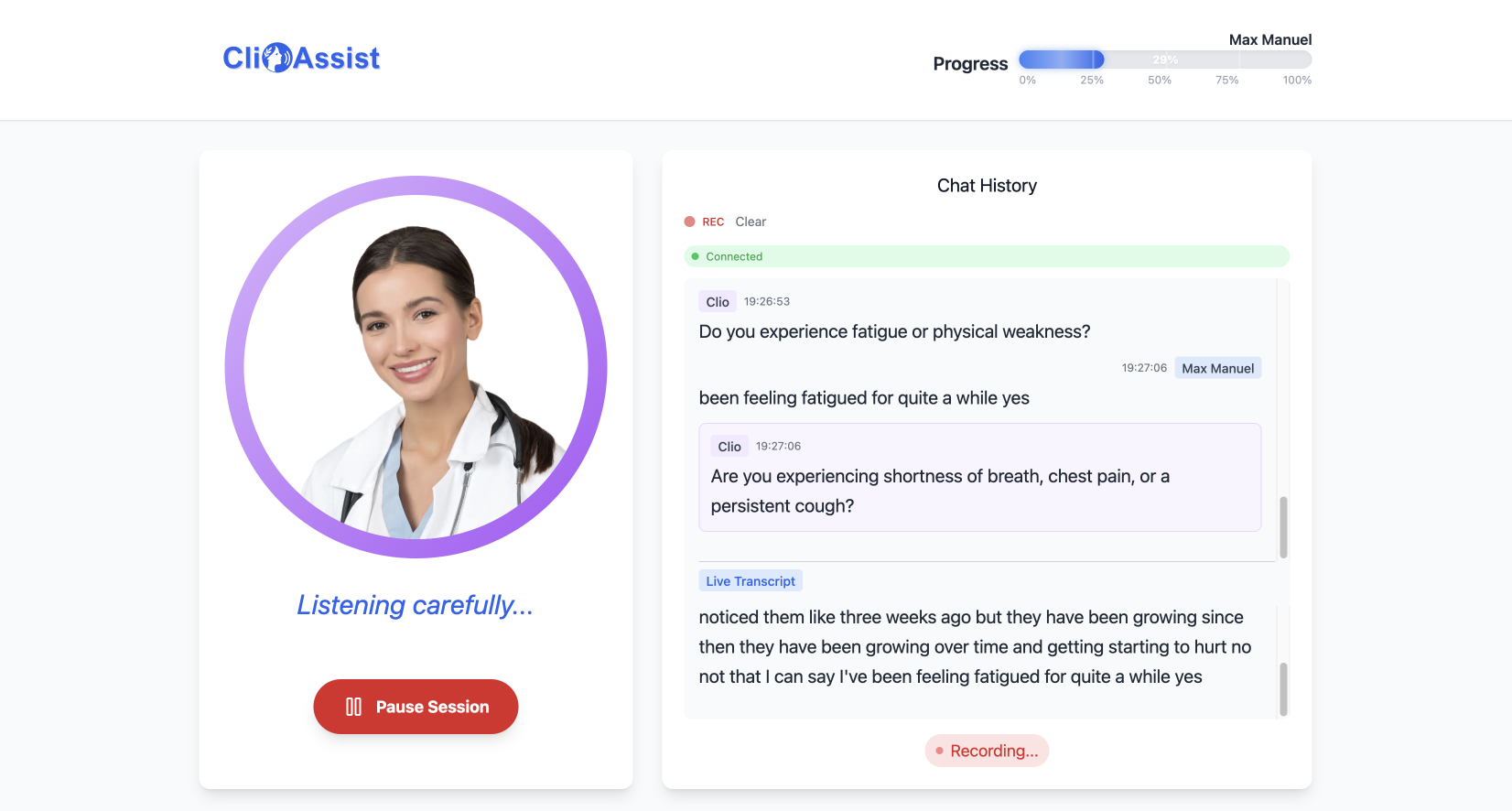
- Structured patient intake: the platform uses conversational AI to conduct structured, empathetic interviews, ensuring no critical data is missed while removing the need for repetitive questioning.
- Intelligent data consolidation: ClioAssist ingests and structures prior findings from PDFs, scans, and referral letters, providing clinicians with a clear patient overview before they begin a consultation.
- Real-time multilingual support: live speech-to-text and translation services eliminate linguistic barriers, ensuring clear communication in diverse patient populations.
- Customisable medical templates: specialty-specific question sets and document templates tailored to individual clinical workflows and documentation standards.
- Administrative dashboard: streamlines day-to-day clinical operations with a centralised control panel for managing patient queues, automatic room assignments, active sessions, and staff workflows.
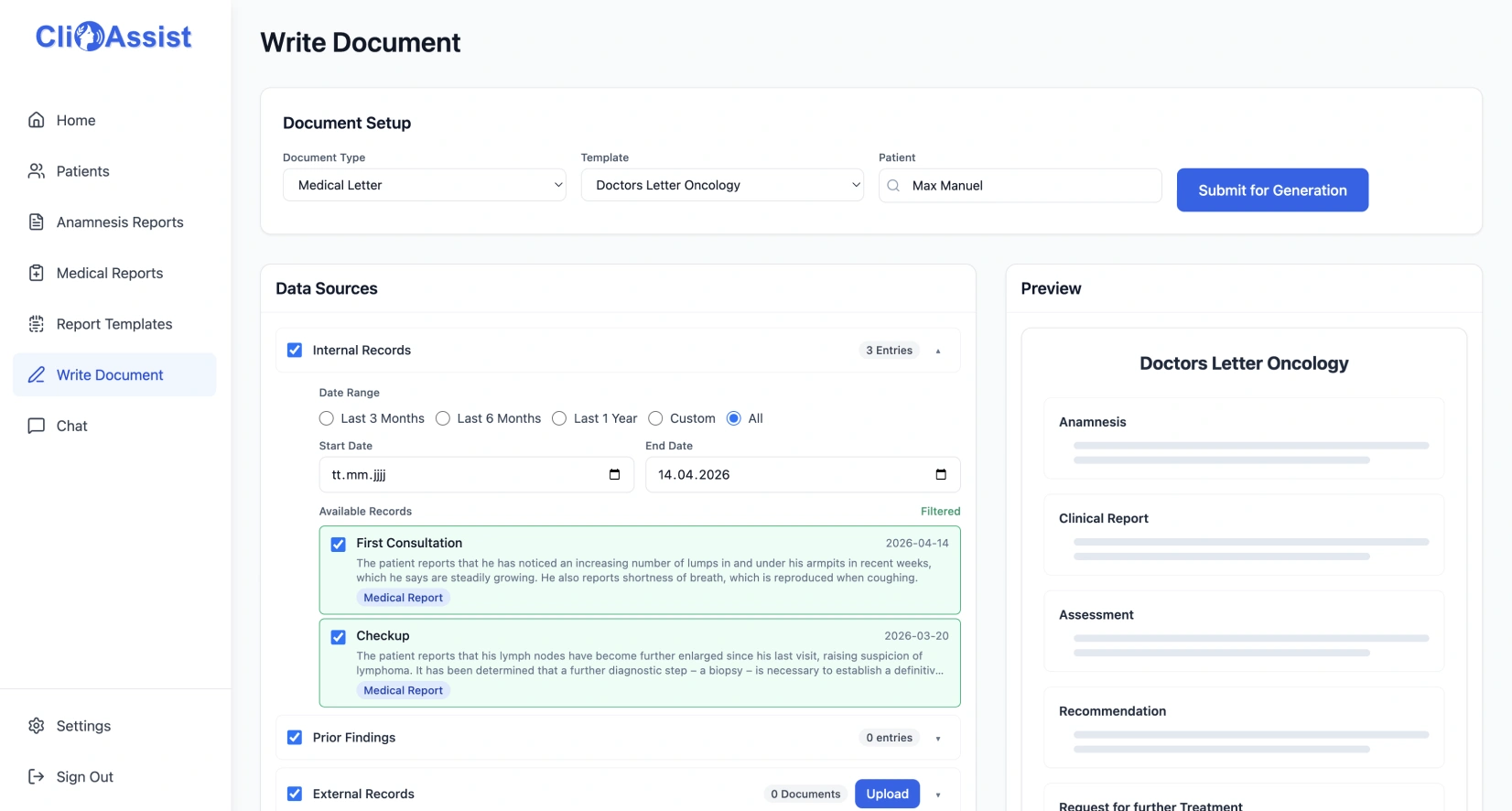
- Automated medical outputs: high-quality documentation, including anamnesis reports, clinical summaries, medical reports and physician letters, can be generated automatically from consultation notes and structured patient data.
A data-sovereign approach to AI clinical documentation
As healthcare organisations adopt automated clinical documentation, data privacy and compliance remain primary concerns. Many AI solutions still rely on external cloud processing, which can introduce questions around data residency, governance, and patient confidentiality.
ClioAssist takes a different approach. With full on-premise deployment, all AI inference and processing takes place on local clinical infrastructure, ensuring that sensitive patient data remains within the healthcare organisation’s own environment. This data-sovereign approach supports GDPR compliance, local governance requirements, stronger operational control, and long-term trust in AI-supported workflows.
For healthcare providers, this means the benefits of AI clinical documentation can be realised without compromising on data control.
Built for long-term digital transformation
At Better, we believe healthcare systems must adapt to better support clinicians, not the other way around. Our platform enables organisations to build open digital health ecosystems where data is separated from applications, making it reusable and built to last.
ClioAssist supports this vision through native integration with GDT and HL7 FHIR standards, ensuring that documentation is not trapped in a silo but can flow efficiently across practice management and hospital information systems. By combining ClioAssist’s documentation capabilities with the Better Platform foundation, healthcare providers can modernise clinical workflows at their own pace while building long-term resilience and better care outcomes.
Discover how ClioAssist, now available on Better Marketplace, can help transform clinical documentation workflows.
Partner with Better
Access a growing healthcare ecosystem built on open standards and expert support.