



A hospital research team may need to answer questions such as: how many of our patients have stage IV non-small cell lung cancer (NSCLC), an EGFR mutation, and an ECOG performance status of 0 to 1? The hospital may already have treated those patients and documented each of those details, but much of that information sits in clinic notes, pathology reports, and other free-text documents rather than structured fields. Answering population-level questions like this can still mean opening records one at a time.
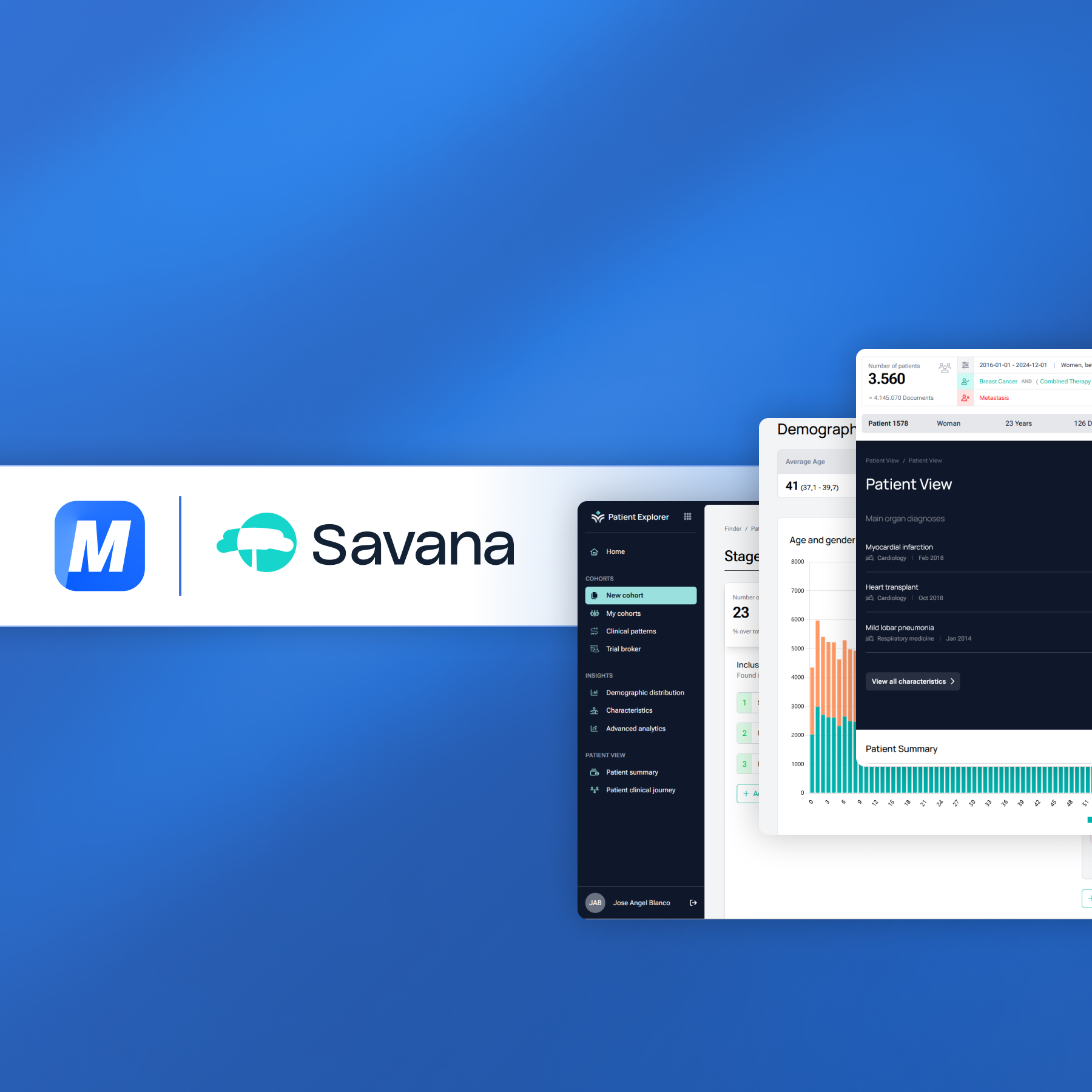
Savana Manager Suite, live now on Better Marketplace, uses clinical natural language processing (clinical NLP) to turn narrative clinical data into structured, research-ready information for cohort discovery, clinical trial feasibility, and real-world evidence. Within the suite, Patient Explorer provides the cohort-building workspace where research teams can define patient populations and explore the resulting data.
Why is free-text clinical data so difficult to use for research?
Clinical documentation is written primarily to support the care of an individual patient, not to answer questions across thousands of records at once. A clinician reading one pathology report can find an EGFR mutation, just as they can find a disease stage or performance score in the surrounding clinical notes. A research team trying to identify every patient who shares those characteristics faces a different problem: the information might be documented, but that does not mean it is queryable.
That gap has practical consequences. When relevant information is trapped in narrative documentation, trial feasibility and patient identification still depend heavily on manual chart review, while wider questions about research, quality, or planning become harder to answer across the patient population.
How does Savana Manager Suite turn clinical text into structured data?
Many analytics workflows begin once clinical data is already structured. Savana Manager Suite focuses on the step before that. Clinical NLP reads free-text clinical documents, identifies clinically meaningful concepts such as diagnoses, medications, mutations, and scores, and turns them into structured information that can be queried alongside existing data.
Savana is a healthcare technology company specialising in clinical NLP and evidence generation. Savana Manager Suite combines EHRead, the clinical NLP with Patient Explorer, its cohort-building and data-exploration workspace. EHRead processes free-text documentation from the hospital’s existing EHR and structures the identified concepts so they can be combined with information already held in structured fields. Extracted concepts are mapped to standard clinical terminologies including SNOMED CT, ATC, and LOINC, creating an analysis-ready layer across the structured and narrative parts of the record. Patient Explorer then allows teams to use that structured information to define patient populations, examine their characteristics, and explore longitudinal patient journeys.
The EHRead technology has also been evaluated against manually curated gold standards in peer-reviewed research. In one study published in JMIR Medical Informatics, its performance in identifying Crohn disease and related clinical variables was validated against a manually annotated reference standard using records from eight hospitals (Montoto et al., 2022). The technology has also supported published clinical research across several therapeutic areas.
What makes that output usable beyond a single analysis is how it is produced. EHRead was trained exclusively on real electronic health records rather than general-purpose text, and each extracted concept carries provenance back to the source document. That supports the three properties regulatory-grade evidence generation depends on:
- traceability, so a variable can be traced to the words it came from;
- explicability, so the basis of an extraction can be shown rather than asserted;
- and reproducibility, so the same records yield the same variables across sites and over time.
Returning to the NSCLC example, the research team can define the cohort instead of searching through records individually, using those same clinical criteria alongside a date range and relevant demographic parameters. The platform returns the number of patients matching those criteria and shows how that cohort sits within the wider hospital population. From there, researchers can explore demographic distributions, patient characteristics, and longitudinal patient journeys across the cohort.
The work changes shape: from finding relevant information record by record to defining the clinical criteria that matter. More importantly, once that information has been structured, it can be reused when the next research question arises rather than reconstructed from the source documents each time.
What can research teams do once clinical text is structured?
The same structured layer supports several different research workflows rather than serving a single cohort query or study.
- Cohort discovery and exploration: build cohorts from inclusion and exclusion criteria, compare patient counts with the wider population, and explore demographics and patient characteristics.
- Real-world evidence: use structured routine clinical data from defined patient cohorts to generate evidence from everyday care.
- Patient journey analysis: follow longitudinal patient journeys to understand how defined cohorts develop and what happens to patients over time.
- Population-level analysis: interrogate unified clinical data across multiple sources to support research, quality improvement, and planning.
For clinical trial feasibility, Savana Trial Broker matches trials listed on ClinicalTrials.gov against the hospital’s own patient population, applying inclusion and exclusion criteria across structured fields and free text alike, and returning the number of potentially eligible patients for each. A hospital can see which trials it is equipped to run before a sponsor approaches, and translate those criteria into concrete cohorts once it takes one on.
Savana Manager Suite supports operational workflows as well as research ones. The Clinical Pattern Detector continuously analyses structured data and free-text narrative to surface predefined patterns and trends across configurable population groups, organised according to each hospital’s own operational priorities. The aim is faster access to information the organisation already holds, presented in a structured and traceable way.
From narrative records to reusable clinical knowledge
Clinical data should not stop being useful at the end of the encounter that produced it. Much of the information researchers need is already captured while patients receive care, but the form in which it was recorded can make it difficult to reuse at scale. Savana Manager Suite addresses that gap by turning information held in narrative clinical documentation into structured, queryable data that can be reused across research and secondary-use workflows.
Savana Manager Suite operates within governed environments for the secondary use of clinical data and harmonises information from multiple clinical sources into a common data model. The platform is modular, so organisations can begin with data ingestion and NLP-based structuring before adding cohort exploration, trial feasibility, and analytics as their needs develop. The same extraction layer also scales beyond a single institution. Savana Next Generation Registry (SNGR) uses it to deliver a Living Evidence Hub, a multi-institutional evidence capability that runs on a federated model: raw, identifiable clinical data never leaves the source institution, and only anonymised or pseudonymised data is shared for analysis. For a hospital, that means a deployment within its own walls can become the starting point for collaborative research rather than a separate programme of work.
At Better, we believe healthcare data should be captured once and structured for reuse across care, operations, and research. Savana Manager Suite extends that principle to the free text where much of the clinical record still lives, adding clinical NLP and research analytics capabilities to the growing ecosystem on Better Marketplace.
Discover Savana Manager Suite on Better Marketplace.
Partner with Better
Access a growing healthcare ecosystem built on open standards and expert support.