


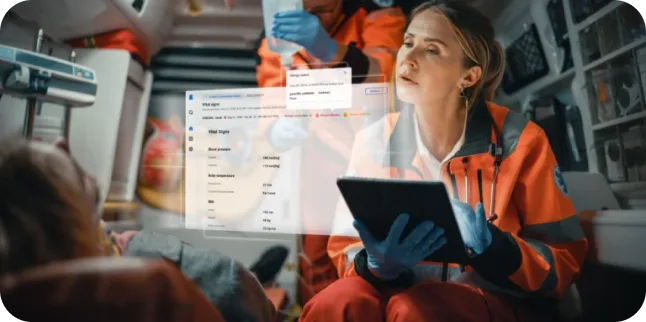



PROMs
Capture, manage, and analyse patient-reported health and process outcomes.
Improve the quality and efficiency of the care processes. PROMs enable you to create custom digital forms or use ready-made templates, bringing flexibility to every stage of the care process.

Addressing the issue
The health community is increasingly becoming aware of the weight patient-reported outcomes have when evaluating and scripting the type of care best suited for the individual patient. Getting patient outcomes of healthcare treatments in a structured way not only supplements clinical patient data but also actively engages the patient in the process of care.
While using collected data is gaining in importance, the process of collecting them remains a problem.
Enter PROMs
With digital data collection using forms created in Studio, you receive the highest flexibility at low to no cost of changing existing or new forms. You also gain greater data accuracy, minimising errors associated with manual entry.


Key benefits of
PROMs

Creation, collection, and management of digital forms.

Individual or group care pathways with one or multiple forms.

Real-time digital dashboards for clinical or process data analysis.

Benchmarking capabilities for data comparison.

Integration with openEHR and FHIR-based repositories to promote interoperability.

Automatisation of care pathways based on form statuses or external system integrations.

Streamlined operational workflows through automated scheduling and notifications.

Contextual launch integration of forms into patient apps and clinical solutions.

A versatile solution
Use PROMs in different health settings and across various stages of patient care. Its structure and functionalities support individuals and care teams in clinical practice, trials and research, and chronic disease management. Furthermore, it can be a great initiative for quality improvements, service and care, and population health management.
Learn how The Christie provides better care using PROMs.

The Christie: modernisation of electronic health record
Step into a future where person-centric care is not just a goal but a tangible reality. A PROMs future.
FAQ
What are PROMs?
PROMs (Patient-Reported Outcome Measures) is a solution that captures patient feedback about their health status and quality of life, directly from the patient’s perspective through structured digital questionnaires.
How does Better support PROMs?
Better provides flexible, digital tools to collect, analyse, and integrate patient-reported outcome data into the clinical workflow and shared care record. Questionnaires are delivered via web or mobile, and responses are stored directly in the openEHR clinical record, making them immediately accessible to clinicians in their normal workflow.
Why are PROMs important?
PROMs empower patients to contribute to their own care record, support value-based care models by measuring what matters to patients, and help clinicians assess treatment effectiveness over time with standardised, comparable data.
What clinical areas use PROMs?
PROMs are used across oncology, orthopaedics, cardiology, mental health, and chronic disease management. Better PROMs has been deployed at The Christie NHS Foundation Trust for monitoring cancer patient quality of life and symptom burden during treatment.
How do PROMs integrate with the clinical workflow?
Better PROMs data is stored in the same openEHR repository as all other clinical data, not in a separate portal. Clinicians see PROMs results within their existing EHR workflow, in context at the point of care. This solves the common problem of PROMs being collected but never reviewed.
What is the difference between PROMs and PREMs?
PROMs (Patient-Reported Outcome Measures) capture what patients report about their health status, symptoms, and quality of life. PREMs (Patient-Reported Experience Measures) capture what patients report about their experience of care, communication, waiting times, staff behaviour. Better Platform can support both.
Studio
The healthcare-specific no-code tools accelerate the development process compared to standard development tools. With the help of a drag-and-drop UI, minimum coding is needed, allowing you to create applications precisely as you want.
Clinical modelling made easy. A web-based clinical modelling tool for openEHR model development enhances productivity and simplifies data modelling tasks. It allows visual authoring of clinical models, archetypes, and templates, including full archetype parsing, validation, flattening, and serialisation, all in a user-friendly environment.
Minimum coding skills required. With the low-code Studio, citizen developers can create and deploy clinical applications quickly and without any code. Studio supports simple and complex data entry forms and clinical data visualisations. Forms and dashboards can be customised and aligned with other applications’ graphic design and UX.
Clinical portal. A configurable, web-based portal gives each member of care team instant access to relevant patient information presented comprehensively. It can be composed of different sets of modules, developed by different vendors, based on the user’s needs and roles. It is accessible from any device at any time.